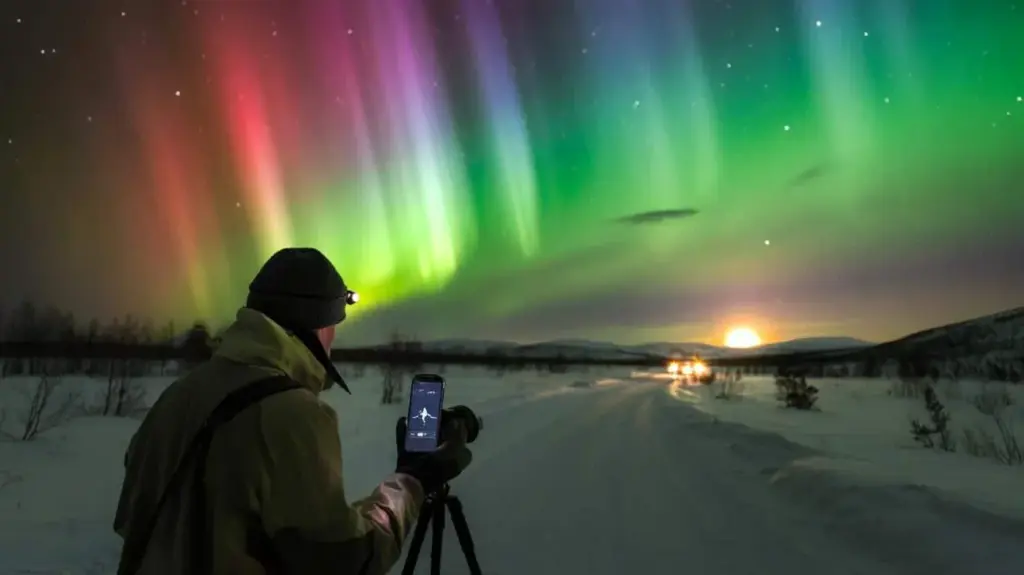
In recent months, powerful solar storms have pushed the aurora borealis much further south than usual, thrilling photographers and confusing casual stargazers. As the current solar cycle heads toward its peak, one veteran aurora hunter says the coming winters could be the best chance in years for people in Europe and North America to witness the lights for themselves — if they know how to get ready.
How a Lapland aurora hunter plans for the perfect night
French guide Jérôme Cantalupo has spent years in Finnish Lapland, running night tours and operating an aurora forecast website. From above the Arctic Circle, he says the sky can glow almost every clear night during winter. Yet the recent solar storms, triggered by violent eruptions from the Sun, have looked different even to him.
“We’re used to frequent auroras here, but the latest solar storm brought hours of intense activity. It just wouldn’t stop,” he explains.
That experience matters for people much farther south. When auroras become visible over France, Germany, or the northern United States, it usually means the underlying solar storm is strong enough that watching conditions in the auroral “heartlands” can be spectacular.
Cantalupo’s approach blends science, patience and a bit of calculated improvisation. He constantly checks near‑real‑time solar data, watches local weather updates and plans escape routes by car to get out from under clouds at short notice.
Why the next few years favour aurora watchers
The Sun goes through an 11‑year activity cycle. Right now it is climbing toward a phase known as solar maximum, when eruptions become more frequent and more energetic. These outbursts, called coronal mass ejections (CMEs), fire huge clouds of charged particles into space. When those clouds hit Earth’s magnetic field, they can trigger strong geomagnetic storms and widespread auroras.
For people in the UK, northern US states, Canada and much of central Europe, this shift in solar behaviour raises the odds of seeing the northern lights without flying to Iceland or Norway. During the strongest events, the shimmering bands can stretch as far south as the Mediterranean or the central US Plains, appearing as pale curtains or glowing arcs on the horizon.
Solar maximum doesn’t guarantee a show every night, but it stacks the deck in favour of frequent and sometimes intense auroral events.
Short‑term forecasts: the 30‑ to 50‑minute window
Professional aurora chasers lean heavily on very short‑term forecasts. These are based on live measurements of the solar wind — the stream of particles flowing from the Sun — taken by spacecraft positioned between the Earth and the Sun.
➡️ Streit um Gemüse im Vorgarten, wie eine zunächst harmlose Idee ein ganzes Dorf tief entzweit
➡️ Rentner weigert sich für an imker verpachtetes land steuern zu zahlen und entfacht eine erbitterte schlammschlacht mit finanzamt nachbarn und familie
➡️ Mieter gegen investoren wenn luxussanierung das viertel spaltet und niemand die folgen tragen will
➡️ A new map beneath Antarctica’s ice reveals twice as many hills… and a giant valley
➡️ Schlechte nachrichten für arbeitnehmer die plötzlich alte überstunden bezahlt haben wollen
➡️ Was wirklich hinter der nächsten strompreiserhöhung steckt und warum sie mehr zahlen obwohl sie weniger verbrauchen
➡️ Mottenfrei wohnen dank einfachem geruch, der die faule gleichgültigkeit deiner nachbarn brutal offenlegt
➡️ Miete frisst leben wie die wohnungsjagd deinen lohn schluckt deine nerven raubt und die stadt in zwei welten spaltet
Cantalupo uses those data to generate a probability map for the next 25 to 50 minutes. For practical purposes, that is the real “alert window” for serious observers.
- Spacecraft measure the speed, density and magnetic orientation of the incoming solar wind.
- Algorithms translate those measurements into a forecast of how disturbed Earth’s magnetic field will become.
- The resulting estimate can show which latitude bands are most likely to see auroras in the next half hour.
The catch: you need to refresh these tools often. Conditions can change quickly as new pulses of particles arrive or the solar wind tilts in a more favourable direction.
Three‑day aurora forecasts: handy, but not foolproof
Longer‑range outlooks, stretching across one to three days, can help people plan road trips or nights away from city lights. They draw on images of the Sun’s surface, magnetic models and simulations of how material from CMEs will travel through space.
Yet the same storm that recently lit up the skies over France shows the limits of this approach. The shockwave of particles reached Earth faster than models predicted, giving observers much less warning than expected. In that case, three‑day maps were practically obsolete by the time the main storm struck.
Long‑range aurora forecasts are best treated as “heads up” notices, not guarantees. The real decision point still comes on the day, or even the hour, of a potential event.
Choosing the right spot: darkness beats latitude
Once an alert pops up, location becomes everything. Cantalupo insists that the biggest mistake people make is focusing only on how far north they are and ignoring light and cloud cover.
Get away from city glow
Artificial lighting drowns out the dimmer parts of an aurora and can make even a strong display look washed out. Street lamps, car parks and illuminated buildings all cut down on contrast.
For a decent view, he recommends driving at least 20 to 30 minutes outside medium‑sized towns and even further from big metropolitan areas. Ideally, you should stand somewhere with a clear view of the northern horizon, such as a field, beach or hilltop.
Watch the clouds as closely as the Sun
Even a promising geomagnetic storm is useless if a thick cloud layer rolls in. In Lapland, Cantalupo often spends evenings racing between weather gaps, following radar images and satellite photos on his phone. A similar strategy works in the UK and North America: make a shortlist of dark‑sky spots in different directions so you can shift quickly if clouds arrive.
| Condition | Good for auroras? | What to do |
|---|---|---|
| Clear, cold, calm night | Excellent | Head to your darkest nearby spot and stay at least 1–2 hours |
| Broken clouds | Possible | Look for gaps; move if a neighbouring area looks clearer on radar |
| Thick overcast | Poor | Monitor forecasts but save your energy unless a major storm is expected |
When to look: timing your night
Auroras can appear at almost any hour, but there are patterns. In high‑latitude regions such as Lapland, strong displays often cluster between 9 p.m. and 2 a.m. local time. During major geomagnetic storms, activity can persist all night and even spill into twilight.
For observers further south, patience rewards. An aurora might first appear as a faint, greyish band low on the horizon, easily mistaken for a distant cloud or light pollution. Your eyes need at least 15 to 20 minutes away from bright screens or headlights to fully adapt to darkness.
If you think you see a static pale glow in the north, keep watching. Subtle ripples, shifting curtains or vertical pillars often reveal that you’re looking at an aurora rather than stray cloud.
Capturing the lights with a camera
The human eye can miss colours that a camera picks up easily. That is why social media is filled with vibrant aurora shots that look more dramatic than what witnesses reported seeing in person.
A basic tripod and a camera with manual settings are usually enough. Cantalupo advises starting with exposures of 5 to 10 seconds at a high ISO, then adjusting depending on how bright and fast‑moving the display is. On recent phones, “night mode” or astrophotography options can also produce impressive results, though you may need to prop your device against a solid surface.
What the colours really mean
Aurora hunters pay attention to colour as a clue to what is happening above their heads. Green curtains, the most common shade, appear when energetic particles collide with oxygen atoms roughly 100 kilometres up. Higher‑altitude oxygen, closer to 200 kilometres, can glow red during more powerful storms.
Violet or purplish fringes, which the Lapland all‑sky cameras recorded during a recent CME event, tend to signal the presence of ionised nitrogen. Those shades often show up on the lower edge of fast‑moving auroral arcs.
Solar storms: beauty with side‑effects
While auroras are harmless spectacles for ground‑based observers, the same geomagnetic disturbances can cause issues for power grids, long‑distance radio communications and satellites. Engineers monitor solar weather carefully, adjusting operations when a strong CME is on its way.
For ordinary people, the main risk lies in underestimating rural conditions rather than any cosmic hazard. Temperatures during clear winter nights can drop sharply. Experienced chasers stress insulated boots, layered clothing and hand warmers, especially when you are standing still for long periods, staring at the sky.
What beginners should watch for in solar forecasts
A growing number of apps and websites translate complex solar‑wind data into simple traffic‑light warnings. Beneath those colours sit a few key indicators that aurora hunters track:
- Kp index: a global measure of geomagnetic disturbance, scaled from 0 to 9. Higher numbers mean auroras can reach lower latitudes.
- Solar wind speed: faster flows, often above 600 km/s, tend to energise brighter displays.
- Bz component of the magnetic field: when this value turns strongly negative, energy couples more efficiently into Earth’s magnetosphere, boosting auroras.
Beginners do not need to master the physics, but recognising these terms helps you judge when social media excitement matches genuine potential.
From casual skywatcher to dedicated “chaser”
For many, the first glimpse of an aurora starts with a neighbour’s message or a trending post. Cantalupo suggests treating these viral moments as a starting point, not the whole story. After one bright storm, local enthusiasm often leads to a queue of night‑owls booking organised trips, buying tripods and comparing apps.
A practical path is to begin with low‑effort attempts from just outside your town during strong forecast periods. If that sparks something deeper, you may find yourself planning winter holidays around aurora seasons, learning basic astronomy and building a mental map of dark‑sky spots within a two‑hour drive. Aurora chasing can become a gentle gateway into wider space weather awareness, where a glowing sky is not just a pretty picture but the visible trace of our star’s restless moods.