
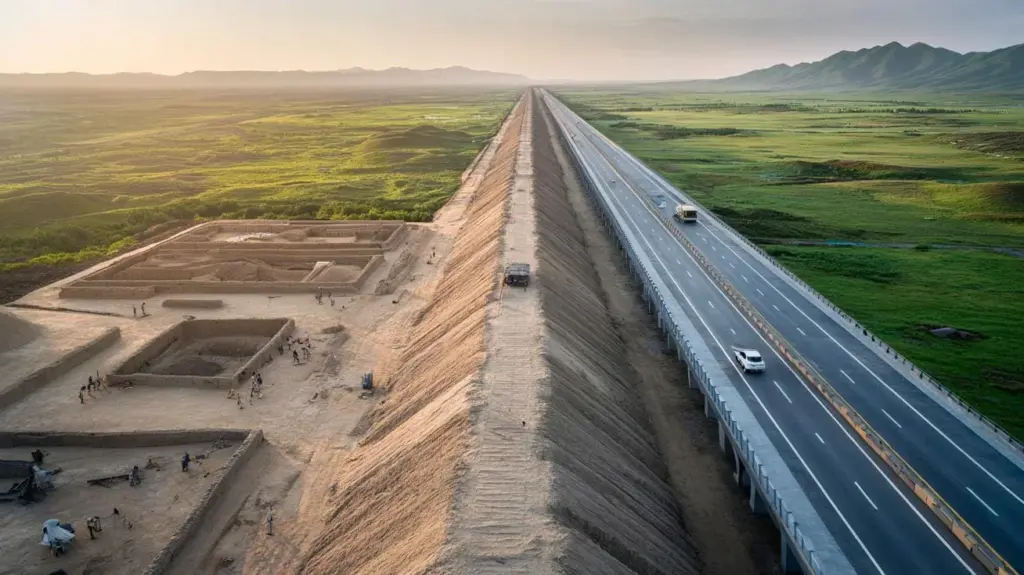
For decades, historians suspected that a massive imperial road once sliced across northern China, binding the first unified Chinese empire together. Now, a newly excavated stretch of that route is rewriting what we thought we knew about ancient infrastructure, military strategy and state power.
An ancient highway hidden beneath the soil
Archaeologists in China have revealed a 13-kilometre section of an imperial road built more than 2,200 years ago, during the short but transformative Qin dynasty. The find lies in Shaanxi province, in the north of the country, and forms part of the so‑called Qin Imperial Road, which once ran for nearly 900 kilometres.
The project was announced by the Yulin Cultural Heritage Conservation Institute in early December, after months of survey and excavation work that combined boots-on-the-ground digging with satellite imagery and remote sensing.
This was not a simple dirt track but a fully planned transport corridor, engineered at a scale comparable to a modern multi-lane highway.
Excavations show a meticulous layout: straight trenches, packed-earth embankments, thick layers of compacted road surface and man‑made fillings in natural valleys, all designed to keep the route as straight and stable as possible across challenging terrain.
A footprint as wide as a motorway
The measurements are striking. On average, the road is about 40 metres wide. In some places, it spreads to around 60 metres. That footprint rivals, or even surpasses, several modern intercity roads.
Engineers working more than two millennia ago appear to have aimed for both capacity and resilience. A platform of rammed earth, a traditional Chinese construction technique, underpins the roadbed. Successive compacted layers above would have resisted erosion and heavy use.
At its broadest, the Qin imperial road could have carried the ancient equivalent of four lanes of modern traffic side by side.
While there were no trucks or cars, the width allowed streams of chariots, pack animals, infantry columns and carts loaded with grain or weapons to move without clogging the route. That kind of throughput mattered in an empire built on rapid troop movements and tight central control.
➡️ Did you know the tit acts as an ecological barometer in your garden? Here’s why
➡️ Rentner muss für wiese vom imker landwirtschaftssteuer zahlen
➡️ Wer an teurem wein schuld ist winzer der staat oder wir alle ein streit der genussfreunde spaltet
➡️ Backofen oder Airfryer, welches Gerät das Stromduell wirklich gewinnt und bares Geld spart
➡️ This is the household item that boosts damp and mould the most this winter (and it’s very easy to look after)
➡️ In the desert, they are building an “artificial sun” to power cities
➡️ Winter sales at Boulanger: our selection of must‑grab deals
➡️ Wenn der frühstückstisch zum schlachtfeld wird wer brotkrumen hasst und wer im chaos seine freiheit verteidigt
A strategic tool for the first Chinese empire
The road dates back to the reign of Qin Shi Huang, the first emperor of a unified China, who ruled from 221 to 210 BCE. He is best known outside China for the Terracotta Army, but his rule was also marked by sweeping infrastructure campaigns.
Ancient historian Sima Qian wrote that construction of this imperial artery began around 212 BCE and finished by 207 BCE. If these dates hold, the project was completed in around five years, a remarkable pace given the tools of the time and the enormous workforce required.
Connecting capital and frontier
Textual sources and the new excavations indicate that the road linked Xianyang, the Qin capital near today’s Xi’an, to Jiuyuan, close to modern Baotou in Inner Mongolia. In practical terms, this route tied the political nerve centre of the empire directly to its vulnerable northern frontier.
That frontier was under threat from the Xiongnu, nomadic groups whose raids posed a long-term challenge. Speed of response was everything.
- Troops could be deployed to the border far faster than via ordinary tracks.
- Grain, weapons and supplies could be transported in large volumes.
- Messages could travel more reliably through relay stations along the road.
Close to the newly exposed section, archaeologists have identified the remains of an ancient postal and relay site, active during both the Qin and subsequent Han dynasty. The complex would have housed couriers, stables and storage, turning the road into a spine for administration and trade, not just warfare.
Not just walls: a mobile defence system
The Qin Imperial Road has been described in Chinese heritage publications as the second most significant defensive project of ancient China, ranking only behind the Great Wall. That comparison reveals a key point: where the wall stood as a static barrier, the road functioned as a dynamic instrument of control.
If the Great Wall was a shield, the imperial road was a sword, allowing the state to project power rapidly over vast distances.
This mobility gave the early Chinese empire an edge. Soldiers and officials could appear almost anywhere along the northern corridor on short notice. Local rebellions or incursions could be contained before they spread. The road effectively shrank the empire, at least in terms of travel time.
A rediscovery powered by modern tech
Despite references in classical texts, much of the Qin Imperial Road had long slipped from view, buried under farmland or overlain by more recent tracks. That has begun to change thanks to satellite imagery and advanced remote sensing techniques.
Researchers have now mapped nine distinct segments that show combinations of cuttings, hardened surfaces and large earthworks. Some fragments were first recognised in the 1970s, but the latest investigations reveal their true scale and cohesion as part of a single, coordinated project.
| Feature | Qin imperial road | Modern highway (typical) |
|---|---|---|
| Approximate width | 40–60 m | 20–35 m |
| Main purpose | Military, administrative, logistics | Civilian transport and freight |
| Construction material | Rammed earth, compacted soil layers | Asphalt, concrete, graded aggregate |
| Alignment | Near-straight over long distances | Engineered for safety and terrain |
How ancient road-building actually worked
Rammed earth construction, used for both city walls and roads, involved pounding moist earth into dense layers inside wooden frames. Workers repeated the process until they achieved a hard, stone-like structure. The method was labour-intensive but surprisingly durable.
For a road, engineers would first cut a straight trench, build up embankments where ground dipped, and fill in hollows to avoid sharp slopes. Layers of graded earth, gravel or other material could then be compacted to create a firm surface that shed water and resisted ruts.
In practical terms, that meant thousands of labourers and conscripted workers, coordinated over dozens or hundreds of kilometres, all following a common design. For historians of state power, this is as revealing as the road itself.
Why this matters for modern infrastructure debates
For today’s engineers and planners, the Qin Imperial Road is a reminder that large-scale connectivity is not a recent invention. Some core principles have barely changed: straight alignments reduce travel time; wide corridors improve capacity; reliable surfaces support heavy loads.
The find also shows how infrastructure and politics intertwine. In the Qin case, a centralised authority used massive projects to bind diverse regions into a single political entity. Roads, like walls, became physical expressions of power and ambition.
There is a flip side. These endeavours came at a human cost. Historical texts mention heavy corvée labour during Qin Shi Huang’s reign. Projects such as the imperial road, canals and walls likely relied on forced workers, many of whom suffered or died during construction. When we admire the engineering, that social reality sits in the background.
From ancient highway to modern heritage
As more sections of the road surface, Chinese heritage officials face decisions familiar to site managers worldwide: how much to excavate, what to leave buried for future research, and how to present the remains without damaging them.
Future visitors could one day walk along reconstructed stretches, compare the width to a motorway, and picture lines of Qin soldiers and carts grinding across the same ground. For local regions, that kind of heritage tourism can bring income, but it also demands careful management to protect fragile features.
For readers trying to make sense of “2,200-year-old infrastructure”, one helpful comparison is travel time. A well-maintained ancient road might allow a courier on horseback to cover around 80–100 kilometres per day, especially with relay stations. Over a 900‑kilometre route, that could bring messages from capital to frontier in just over a week. In political terms, that speed could decide the outcome of a border clash, a tax revolt or a succession crisis.
The Qin Imperial Road, resurfacing piece by piece, offers a concrete case study of how engineering, military planning and central authority came together long before modern states laid down their first asphalt strip. It suggests that when we look at a satellite image of a highway network today, we are seeing the latest version of an idea that emperors were already testing, with rammers and earth, more than two millennia ago.