
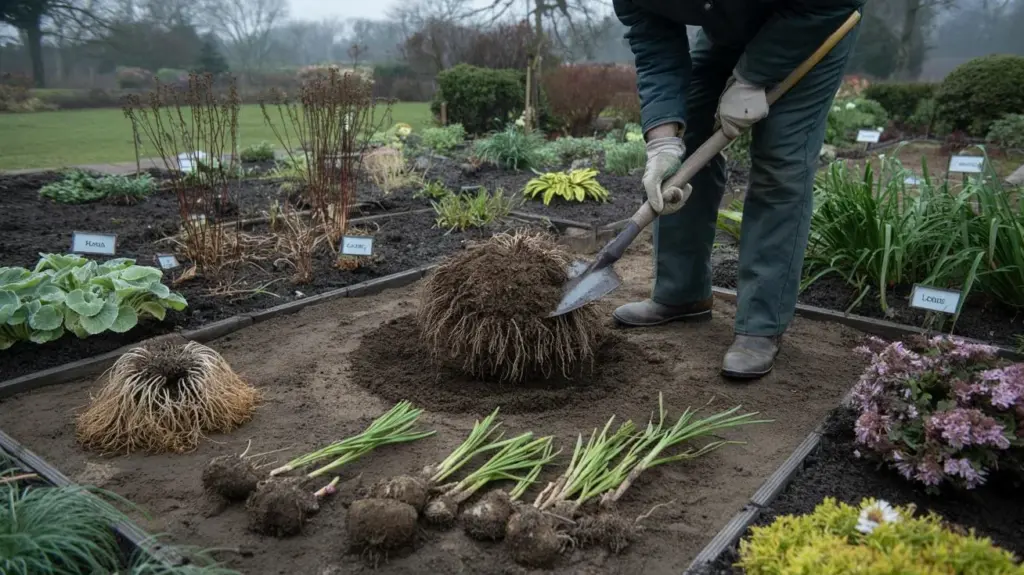
Yet right now, in this quiet pause before plants wake up, a single sharp spade can turn one tired clump into a whole crowd of new perennials. The trick sits halfway between thrift and strategy, and the people who use it best are often the professionals preparing their beds for spring.
Why late January is a secret weapon for fuller borders
Many home gardeners wait for mild, sunny days before touching their plants. That timing suits us, not the plants. When shoots are emerging and sap is surging, every disturbance demands energy from the plant at the very moment it needs it for growth and flowering.
In late January, most hardy perennials are fully dormant. Above ground, there is little to see. Below ground, the sap has retreated and the root system ticks over on minimum power. That dormancy is a blessing.
Working on perennials while they are dormant means less stress, quicker recovery, and stronger flowering when spring arrives.
The soil usually helps as well. Outside of hard frost, winter rain leaves it softer and easier to work. That combination makes late January one of the most efficient slots of the year for a simple but powerful technique: dividing mature clumps of perennials.
This is the hidden routine behind many lush English-style borders and well-designed city planting schemes. Those gardens are not built only on fresh nursery purchases. They rely heavily on systematically divided and repositioned plants that have been in the ground for years.
Which perennials really benefit from winter division
Not every plant appreciates being dug up in midwinter. The best candidates are tough, deciduous perennials that retreat completely or almost completely below ground once cold sets in.
Ideally, you target clumps that have been in place for three to four years or more. These often form a woody, exhausted centre with fresher growth around the edges. Flowering declines, and some plants start to flop or suffer from disease.
Top candidates you probably already grow
- Autumn asters – Reliable and vigorous, but prone to mildew when crowded. Division helps air circulation and keeps them upright.
- Daylilies (Hemerocallis) – Chunky, fleshy roots handle rough treatment well and turn one overgrown clump into several generous fans.
- Phlox paniculata – Heavy feeders that lose punch if left untouched. Division restores flower power and size.
- Coreopsis and rudbeckia – Low-fuss stalwarts for sunny spots, perfect for spreading colour through large beds.
- Hostas – As long as the ground is not frozen solid, splitting hostas before their “horns” emerge gives them time to root before slug season.
Some plants are best left alone at this time of year. Winter and very early spring bloomers, such as hellebores, resent being lifted while they are gearing up to flower. Tree peonies and herbaceous peonies also sulk, or even fail to flower for a year or two, if disturbed carelessly.
➡️ Schlechte nachrichten für einen rentner der einem imker land verpachtet hat er muss landwirtschaftssteuer zahlen ich verdiene damit kein geld eine geschichte die die meinungen spaltet
➡️ Wölfe im land fluch für bauern segen für naturschützer
➡️ Winter sales at Boulanger: our selection of must‑grab deals
➡️ Rentenalter steigt, Beitragsbemessungsgrenze bleibt, während Millionen Beschäftigte trotz Vollzeitjob ihre Miete kaum zahlen können
➡️ Rentner mit kleinem nebenverdienst durch imkerei oder landverpachtung sollen plötzlich volle steuern zahlen und lösen einen aufschrei über soziale gerechtigkeit aus
➡️ Rentner muss für wiese vom imker landwirtschaftssteuer zahlen
➡️ Immer mehr ungeimpfte kinder im wartezimmer
➡️ Check your cupboards: some tins of sardines could be worth a small fortune
Focus on robust, fully dormant perennials with tired centres; avoid winter and early-spring bloomers that are already preparing to flower.
Step-by-step: how to divide clumps without wrecking them
A lot of gardeners hesitate at the key moment. The plant looks solid and established, and the idea of hacking it into pieces feels brutal. In reality, division works like surgery: a short shock that leads to a renewed, healthier plant.
Preparing the lift
- Pick a day when the soil is workable, not frozen or waterlogged.
- Use a sharp spade or garden fork; blunt blades tear rather than cut.
- Cut a wide circle around the clump to preserve outer roots.
Once you have loosened the soil all around, lever out the entire clump. Give it a firm shake or tap to shed excess earth. You will often see a hard, woody middle where flowering has declined. That central core can go straight on the compost heap.
Two ways to split the clump
How you divide depends on the plant’s root structure.
- By hand – For fibre-rooted perennials like some asters and rudbeckias, you can often tease the clump apart into sections by pulling gently but firmly.
- By blade – For dense or fleshy-rooted plants such as daylilies or mature hostas, place the clump on the ground and cut it like a cake, using a spade or sturdy knife.
Each piece, often called a “division,” needs at least one or two visible buds or shoots and a decent amount of root. Do not be alarmed by snapping sounds: these perennials are built to survive far harsher conditions than a gardener’s spade.
As long as each division carries live buds and a solid root system, the plant will usually bounce back with renewed strength.
Replanting: what you do next decides the success
Fresh divisions dry out quickly in winter air and wind. Once you have split a clump, aim to replant immediately. If that is not possible, “heel them in” temporarily in a spare bed or keep them in pots of damp compost until you can move them.
Giving new plants the best start
- Loosen the new planting area to spade depth.
- Mix in well-rotted compost or a slow-release organic fertiliser such as bonemeal.
- Plant so the crown – the junction between roots and future stems – sits at soil level.
- Firm the soil around the roots with your hands to remove air pockets.
- Water, even in cold weather, to settle the soil around the roots.
Cold protection matters more than many gardeners think. Freshly disturbed roots are sensitive to sharp temperature swings.
A simple mulch of fallen leaves, straw or compost around each division can buffer winter cold and keep the soil evenly moist.
A 5–8 cm layer of organic mulch helps in several ways: it limits frost penetration, reduces evaporation from the soil surface, and gradually feeds the young roots as it breaks down.
The maths: from one clump to a whole border
Dividing perennials is as much about budgeting as botany. A single, overgrown daylily clump can easily yield five or six strong divisions. At typical nursery prices, that can represent the equivalent of dozens of pounds’ worth of plants generated in under half an hour.
| Perennial | Age of clump | Typical number of new plants |
|---|---|---|
| Daylily | 4–5 years | 4–6 |
| Autumn aster | 3–4 years | 5–8 |
| Phlox paniculata | 3–5 years | 3–5 |
| Rudbeckia | 3–4 years | 4–7 |
There is also a design payoff. Older, neglected clumps often collapse in wet weather and flower unevenly. Dividing them creates younger, more uniform plants that fill space better and resist disease.
Repeating the same variety in several spots ties a garden together visually. A drift of the same aster echoing through different beds looks deliberate and cohesive, like something from a professional planting plan, even when all the plants started from one original clump.
Common worries and how to handle them
Two fears come up again and again: frost and failure. Cold is a real factor, but timing and mulch go a long way. Avoid working when the soil is frozen solid or after days of heavy rain. Choose a dry, cold-but-not-arctic spell. Once replanted and mulched, divided perennials usually shrug off ordinary winter weather.
Failure tends to come from extremes: either divisions are cut too small, with barely any roots, or planted into compacted, starved soil. Aim for chunky pieces, not slivers, and give them a modest upgrade in soil quality rather than planting into a concrete-hard bed.
Think of division as rejuvenation, not punishment: an old, congested clump has less chance of thriving than three younger plants with space and fresh soil.
Extra gains: sharing, swapping and planning ahead
Once you start dividing, you may quickly have more plants than you need. That surplus can be the basis for neighbourly swaps or for filling problem areas where annuals rarely perform well. Perennials grown from your own garden stock are already adapted to your soil and microclimate, which often makes them tougher than shop-bought plants.
Winter division also forces you to look at the structure of your beds while foliage is out of the way. You can plan where strong blocks of colour should sit, where taller plants need to move back, and where gaps appear every summer. Each new division is a chance to correct those long-standing layout gripes.
For newer gardeners, this is a handy moment to learn some useful terms. “Dormancy” refers to the plant’s low-activity state in winter; growth slows, but the plant is very much alive. The “crown” is the point where roots meet shoots, and planting too deep above this can cause rot. “Division” simply means separating one plant into several self-sufficient units, each capable of becoming a full specimen.
Used once, division gives an instant boost. Used every few years, it becomes a quiet engine behind a garden that looks generous without constant spending. Late January, when most people are still convinced nothing happens outside, is when that engine can be tuned for the whole year ahead.