
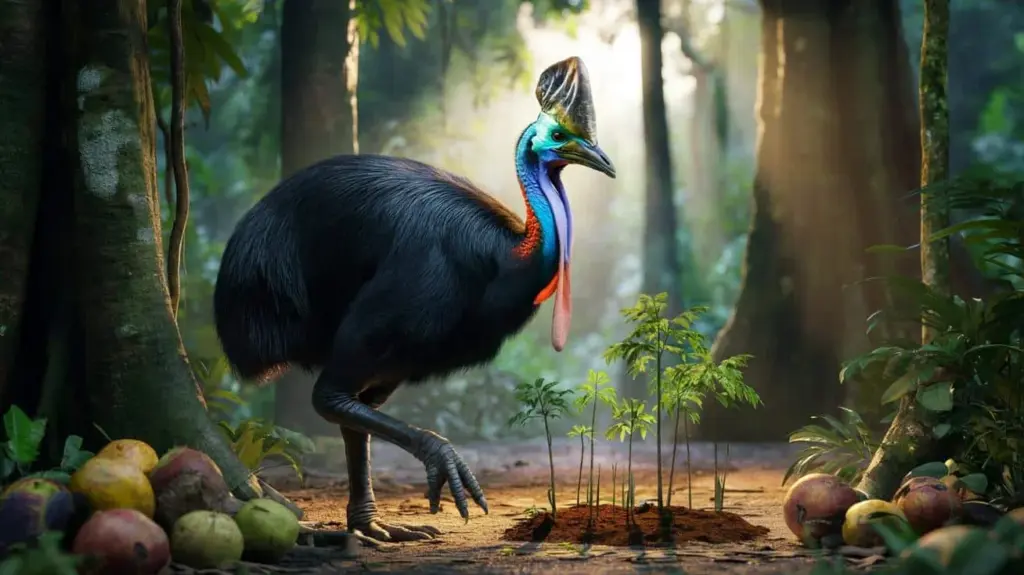
Tourists are warned to keep their distance, locals grow up with stories of its lethal kick, and rangers treat it with measured respect. Still, this so‑called “world’s most dangerous bird” may be one of the quiet heroes holding fragments of ancient rainforest together.
The bird that looks like a dinosaur and runs like a sprinter
The southern cassowary, native to the rainforests of north‑eastern Australia and Papua New Guinea, is a heavyweight among birds. Adults can stand around 1.8 metres tall and weigh more than many teenagers. Their helmet‑like crest, called a casque, and their vivid blue and red necks give them a distinctly prehistoric profile.
They do not fly. They do not need to. Muscular legs power them through dense forest at speeds reaching roughly 50 km/h. On each foot, a long, dagger‑shaped claw on the middle toe can reach about 12 centimetres.
One well‑aimed kick from a cassowary can disembowel a dog or a wild pig, and can kill a human.
This ability has shaped both their reputation and their relationship with nearby communities. For generations, people in the highlands of Papua New Guinea have treated the cassowary with a mixture of fear, respect and spiritual awe.
From weapon to symbol of status
Archaeological and ethnographic research shows that cassowaries were more than just dangerous neighbours. Their bones were carefully shaped into weapons and ceremonial items. In parts of the Sepik region, warriors carried daggers carved from cassowary femurs, prized for their toughness and fine polish.
Recent analysis of one such dagger by researchers at the University of Cambridge confirmed it was made from a cassowary bone, chosen deliberately over pig or dog bones because it resisted breaking. The object was not just practical. It signalled bravery, hunting skill and social rank.
Cassowaries also appear in rock art and mythology. In caves such as Auwim in Papua New Guinea, stylised bird figures and traces of beaks and wings are interpreted as cassowaries linked to creation stories and clan origins. For many communities, this bird is stitched into ancestral narratives rather than just local wildlife lists.
“World’s most dangerous bird”… with a complicated reality
Stories about lethal attacks are easy to share, especially in the age of viral headlines. Yet recorded deaths linked to cassowaries are extremely rare. The most recent well‑documented case comes from 2019 in Florida, where a man keeping cassowaries on private land fell and was severely injured by one of his birds.
➡️ Schlechte nachrichten für weinliebhaber und winzer warum ein versteckter zuschlag auf jede flasche kommt und wie sich gastronomie verbraucher und politiker darüber zerstreiten
➡️ Changing tyres on your electric car now costs more than recharging it
➡️ Rentner soll landwirtschaftssteuer zahlen und erzählt von einer bienengeschichte die das ganze dorf spaltet
➡️ Wirksamer als Unkrautvernichter und natürlicher 3 Handgriffe für makellose Wege
➡️ Warum web_search_with_snippets Fact-Checking ohne volle Page-Loads beschleunigt
➡️ Warum ein geplanter windpark eine ganze region spaltet und wütende nachbarn plötzlich von verrat an der heimat sprechen
➡️ So zerstören negative kollegen ihr arbeitsklima und warum sie trotzdem nicht das recht haben sich zu beschweren
➡️ Wenn die pacht zum streitfall wird wie ein rentner der einem imker nur einen gefallen tun wollte plötzlich landwirtschaftssteuer zahlen soll und die frage nach gerechtigkeit das dorf in zwei feindliche lager spaltet
Biologists who track wild individuals paint a different picture: a shy, wary animal that mostly avoids conflict.
In natural forests, most cassowary attacks are defensive, triggered when the bird feels trapped or when chicks are at risk.
When startled, a cassowary is more likely to vanish into the trees than charge a human. The risk rises when people try to feed them, corner them for photos, or walk between a father and his young.
A devoted single dad in the rainforest
For such a fearsome animal, the cassowary plays a surprisingly tender role at home. After a short, low‑frequency courtship that includes booming calls carried through the forest, the female lays a clutch of large, pale green eggs. Then she leaves.
The male takes over completely. He incubates the eggs for around 50 days, rarely leaving the nest. Once the striped chicks hatch, he shepherds them through the undergrowth for up to nine months, teaching them where to feed and how to stay hidden.
- Female: lays eggs, may mate with several males in a season.
- Male: builds nest, incubates eggs, raises chicks alone.
- Chicks: follow father, learning feeding routes and forest paths.
This unusual parenting system, where the father is the sole carer, is one reason researchers are so reluctant to disturb nesting territories. Removing one male can mean the loss of an entire generation of chicks in that patch of forest.
Deep bass voices lost in the foliage
For decades, people assumed cassowaries communicated mostly by posture and hissing. More recent fieldwork has shown that they produce some of the lowest calls recorded in any bird species. These booming notes border on infrasound, close to the limit of human hearing.
Thanks to their long necks and specialised bone structure, these sounds can travel hundreds of metres, possibly up to a kilometre, through dense vegetation where visibility is very poor.
Low‑frequency calls let cassowaries stay in contact across thick jungle without exposing themselves to threats.
Researchers suspect these deep notes play roles in mating, territorial spacing and parent–chick contact, although recording and analysing them in the field remains technically difficult.
The forest gardener hidden in plain sight
Beneath the headlines about slashing claws lies the other side of the cassowary’s story: an ecological role so powerful that some scientists see the bird as a walking tree‑planting machine.
Cassowaries are voracious frugivores. They swallow entire fruits, including some up to 10 centimetres across, that many other animals simply cannot manage. These fruits pass through the digestive tract and are deposited as large, nutrient‑rich droppings far away from the parent tree.
A single cassowary scat can contain dozens of intact seeds, effectively functioning as a small nursery bed.
Studies in Australian rainforests suggest that more than 70 tree species rely heavily on cassowaries to spread their seeds. Some are so adapted to this process that their seeds germinate far better after digestion by the bird.
| Plant species | Fruit size | Dependence on cassowary |
|---|---|---|
| Ryparosa kurrangii | Large, fleshy fruit | Germinates reliably only after passing through cassowary gut |
| Various laurels and myrtles | Medium to large fruits | Seed spread greatly boosted by cassowary dispersal |
| Smaller understory trees | Small to medium fruits | Shared among birds, bats and cassowaries |
By carrying seeds across rivers, ridges and disturbed patches, cassowaries help forests heal after storms, logging or cyclones. Seedlings that sprout from their droppings often appear in small clusters, creating pockets of future canopy across the landscape.
When the gardener disappears, the forest changes
In areas where hunting, cars or habitat loss have removed cassowaries, botanists are starting to notice a slow shift in forest structure. Large‑seeded trees become rarer. Faster‑growing, small‑seeded species spread in their place, changing how the forest stores carbon and provides shade and food.
Because so many other creatures, from insects to mammals, rely on fruiting trees, a decline in cassowaries can echo through the ecosystem. Ecologists describe the bird as an “umbrella species”: protect its needs, and many other plants and animals benefit in the process.
Threats: not claws, but chainsaws and cars
For all the attention given to their danger to humans, cassowaries face far greater risks from people than people do from them. Their stronghold is shrinking as coastal rainforests are cleared for housing, roads, agriculture and tourism infrastructure.
Fragmented habitat forces the birds to cross highways and suburban blocks to reach feeding areas. Vehicle strikes are a frequent cause of death in some regions of Queensland. Dogs, especially when roaming off‑lead near forest edges, can injure or kill juveniles.
The biggest threat to a cassowary is rarely a confrontation on a jungle path; it is the loss of safe, continuous forest.
Feeding wild cassowaries, although often done with good intentions by residents and visitors, creates additional problems. Birds become habituated, lose their fear of humans and spend less time foraging naturally. This raises the likelihood of aggressive interactions and road collisions near feeding spots.
How to share a forest with a lethal yet vital neighbour
For anyone walking in cassowary country, a few behavioural rules dramatically reduce risk. Rangers in Queensland and Papua New Guinea tend to give similar advice:
- Stay at least several metres away if you see a bird, and never try to approach for a closer photo.
- Do not feed cassowaries; let them find natural food sources.
- If a bird comes towards you, back away slowly, keep trees or bushes between you and the bird, and avoid turning your back.
- Keep dogs on leads near rainforest edges and signposted cassowary zones.
Most encounters are brief and uneventful. Hikers might only glimpse a dark shape gliding between tree trunks or hear heavy footfalls followed by silence.
Understanding key ideas: seed disperser and umbrella species
Biologists often call cassowaries “large seed dispersers”. That phrase simply means they spread the offspring of plants that other animals cannot handle. Without them, many trees would drop their seeds at their own feet, where competition, disease and poor light limit survival.
The term “umbrella species” is also worth unpacking. Conservationists pick such species not just because they are charismatic or rare, but because protecting the land they need automatically protects many others. In practice, safeguarding cassowaries demands wide, continuous strips of rainforest, low traffic speeds, dog control and limits on hunting. Those same measures benefit everything from small marsupials to rare orchids.
In that sense, the cassowary encapsulates a broader dilemma of modern conservation. A single animal can be both feared and functionally irreplaceable. It can injure a person with one kick, yet its daily movements may plant thousands of trees over a lifetime, stitching scattered forest fragments into something more resilient.