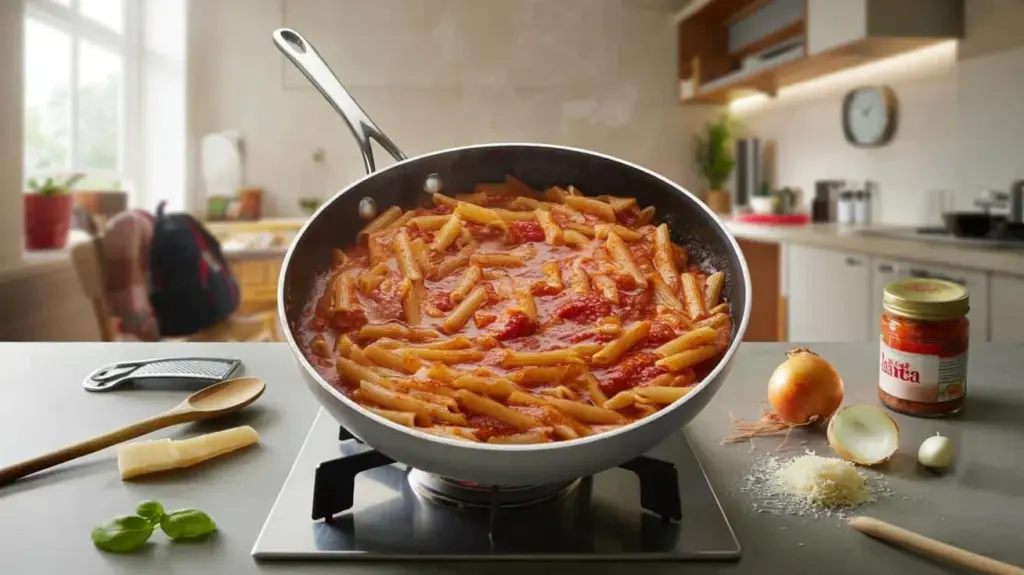
Across TikTok feeds, food blogs and family kitchens, a quiet shift is happening: home cooks are skipping the separate saucepan, pouring everything into one pan, and ending up with pasta that cooks straight in its own sauce.
How pasta cooked in the sauce flipped weeknight dinners
The idea sounds almost wrong to anyone raised on “big pot of water, then sauce on the side”. Yet the so‑called one‑pot pasta, popularised in the US by Martha Stewart, has spread fast through Europe and the UK.
The promise is simple: dry pasta, liquid and flavourings go into one wide pan. Fifteen to twenty minutes later, dinner is on the table, and the washing‑up is barely a blip. For parents juggling homework, commutes and evening meetings, that time saving is not theoretical. It changes what kind of meal feels realistic on a Tuesday night.
Cooking pasta directly in its sauce removes two whole stages: waiting for a huge pan of water to boil, and draining it afterwards.
In a classic method, you heat roughly 1 litre of water for every 100g of pasta. With one‑pot pasta, many cooks use around 1 litre for 500g. That is about five times less liquid to bring to the boil, and far less to handle.
The result is a shorter cooking chain: one pan heats up, one mixture simmers, one dish gets served. No colander, no splashing, no second burner, no juggling pans while the sauce threatens to dry out.
What actually happens in the pan
Less water, more flavour
When pasta cooks in a small volume of liquid, every drop stays in the pan. Instead of pouring a cloudy, starchy cooking water down the sink, the starch stays in contact with oil, tomatoes, garlic or stock.
The liquid reduces as it simmers. Flavours from vegetables, herbs and aromatics concentrate around the pasta rather than diluting in a large pot. That is why many one‑pot pasta dishes taste surprisingly intense despite short cooking times.
A smaller volume of water means stronger flavours, because nothing gets discarded.
➡️ Zwischen klimazorn und staufrust
➡️ Rentner zahlt Landwirtschaftssteuer für imkerland und spaltet die Gemüter
➡️ It Can Kill With One Kick, But Plants Thousands Of Trees
➡️ Schlechte nachrichten für kollegen wenn teilzeit jobber jahre später geld für alte überstunden verlangen und damit firmen in schieflage bringen
➡️ Wenn angst vor kündigung dich teuer zu stehen kommt und dein schweigen deinen lohn frisst
➡️ In the desert, they are building an “artificial sun” to power cities
➡️ Rentner muss für verpachtetes land an imker plötzlich landwirtschaftssteuer zahlen obwohl er daran nichts verdient und der fall spaltet das ganze dorf
➡️ Ein geplanter windpark spaltet eine ganze region und macht aus nachbarn erbitterte gegner die von verrat an der heimat sprechen
Starch turns into creaminess
The science behind the texture is simple but powerful. Pasta is packed with starch, mainly two molecules: amylose and amylopectin. Once the temperature climbs past roughly 60°C, these starches swell and leak into the surrounding liquid. This process is called gelatinisation.
In a standard boiling pot, that starchy water goes straight down the drain when you strain the pasta. When you cook pasta in the sauce itself, that same starch stays put. It thickens the liquid and helps it cling to each piece.
Add fat — olive oil, grated cheese, or a small knob of butter — and that starch works like a bridge between water and oil. It forms a stable emulsion, which your tongue reads as creaminess. That is why one‑pot pasta can feel rich without adding actual cream.
Starch plus fat equals a natural emulsifier, turning a thin liquid into a silky coating that hugs every strand.
From Italian kitchens to your hob: pasta risottata
This “cook in the sauce” approach is not a social‑media gimmick. In parts of southern Italy, especially Puglia, it is known as pasta risottata – pasta treated a little like risotto.
The method often starts cold. Dry pasta goes into a wide pan. Cold water, stock or a loose tomato sauce is poured on top, just enough to cover it generously. This slower heat‑up phase lets starch move into the liquid early, before a rolling boil even starts.
A rough home ratio many Italian cooks use looks like this:
- 1 part dry pasta
- About 2 parts liquid (water, stock or sauce)
- A drizzle of oil or a spoon of fat
- A handful of quick‑cooking vegetables or aromatics
Once the pan hits a strong simmer, a lid can help for the first few minutes to kick things off. After that, the lid usually comes off and the cook stirs often, just as with a risotto, so nothing sticks to the base.
Step‑by‑step: a basic one‑pan pasta routine
The 15‑minute template
For readers curious but slightly nervous, here is a simple framework that works on a standard hob:
| Step | What to do |
|---|---|
| 1. Choose the pan | Pick a wide sauté pan or shallow casserole, around 26–30cm, with a lid. |
| 2. Add ingredients | Tip in 250g dry pasta, 500ml water or stock, aromatics (garlic, onion), a little oil, salt and quick‑cooking veg. |
| 3. Start from cold | Place the pan on medium‑high heat with the lid on for about 3 minutes to launch the simmer. |
| 4. Stir and watch | Remove the lid, stir every 2 minutes, and keep at a lively simmer so the liquid reduces. |
| 5. Adjust | If the pasta is still firm and the pan looks dry, add a splash of water. If it looks soupy, keep simmering. |
| 6. Finish | When the pasta is just al dente and lightly sauced, turn off the heat and stir in grated cheese or herbs. |
This pattern is flexible. You can swap in jarred passata for part of the liquid, scatter in frozen peas or spinach, or add pre‑cooked meat at the end just to warm through.
Where the time savings really come from
Halving prep time is not only about shorter cooking. There is also less thinking and cleaning. With one‑pot pasta you avoid timing two separate elements and coordinating them to finish simultaneously.
You also handle less equipment: one chopping board, one knife, one pan, one spoon. For many households, dishwashing is the real bottleneck after dinner, not the minutes at the stove.
The method shrinks the entire dinner process — from prep to washing‑up — into a single, compact cycle.
Energy usage shifts as well. Heating a smaller amount of liquid demands less gas or electricity than a large pot of water. For people tracking bills, that difference, repeated several times a week, is not negligible.
What can go wrong – and how to avoid it
Stickiness, overcooking and other snags
The most common complaint comes from those first attempts where everything clumps. This usually means too little stirring or too high a heat early on, before the starch has properly dispersed.
Using a very thin pan can also cause hot spots. A heavier base spreads heat more evenly and keeps the sauce from catching. Short shapes like penne, fusilli or farfalle tend to behave better than very long spaghetti strands, which can tangle if not stirred well.
Timing needs attention. Because the sauce thickens as it reduces, the window between perfectly coated and slightly mushy can feel narrow at first. Tasting a piece every minute near the end gives a better guide than staring at the clock.
Beyond the trend: practical ways to use the technique
The one‑pan approach suits more than just pasta. The same starch‑and‑emulsion logic underpins orzo stews, barley “risottos” and even some rice dishes cooked directly in tomato sauce.
Home cooks use the method for batch‑cooking lunches, building a base of pasta and vegetables that can be portioned out and reheated. Others lean on it when hosting, doubling the quantities in a wide casserole so the cook can stay in the room rather than babysit several pans.
For readers wary of soggy noodles, one strategy is to keep a jug of hot water next to the hob. Start with slightly less liquid than you think you need. Add small splashes as the pasta cooks. This keeps the sauce under control and prevents a watery finish.
On the nutrition side, the technique makes it easy to fold in fibre and protein. Tinned beans, sliced mushrooms, shredded greens or small pieces of chicken cook in the same timeframe as the pasta, meaning you can build a more balanced bowl without extra pans.
Finally, a quick term worth keeping in mind: “al dente” simply means pasta that is firm to the bite, not crunchy, not soft. With one‑pot pasta, hitting that point matters even more, because the pasta continues to absorb a little liquid off the heat. Stopping just shy of your ideal texture lets the dish settle into that sweet spot as you carry it to the table.