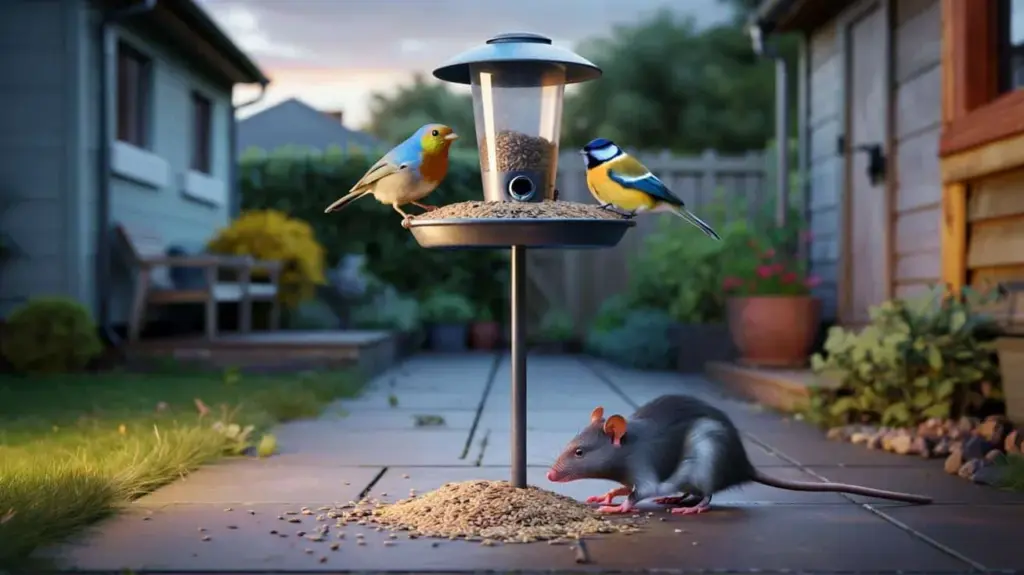
Across towns and suburbs, people trying to help small birds through winter are unknowingly laying on a nightly banquet for rats. With a few simple changes, you can keep the robin and blue tit visits – without turning your garden into a rodent service station.
When feeding birds quietly invites rats in
Winter strips away the margin for error in urban wildlife. Every species is hunting for easy calories, and rats are experts at finding them. They are not wandering into your garden at random. They are following two things: smell and habit.
Once a rat has located a reliable food source, it will return again and again, and bring companions with it.
Spilled seed under a feeder is a strong signal. To a rat, that mess means free energy with almost no effort. Add shelter – a shed, a compost heap, a low deck – and you have all the basics of a rat-friendly site.
The risk goes far beyond a few missing seeds. Rats shed urine and droppings wherever they feed. That can contaminate patios, children’s play areas, pet bowls and, of course, the birds’ feeding ground. They can also gnaw their way into garages, sheds and sometimes homes once they associate your property with food.
The goal is not to stop feeding birds. The goal is to feed birds in a way that starves rats of opportunity.
Turn your feeder into a fortress
Designing a feeder setup that frustrates rats means thinking like a climber and a jumper. Rats can scale rough surfaces, squeeze through gaps the width of a thumb, and leap surprising distances if they have a solid launch point.
Location is your strongest weapon: a well-placed feeder can make access physically impossible for rats.
Height and distance: the two non‑negotiables
- Raise the feeder high enough: Position it at least 1.5–1.6 metres off the ground. That exceeds the range of a vertical jump from most rats.
- Keep it away from “launch pads”: Place it at least 2 metres from walls, fences, shrubs, trellis, garden furniture or low branches that could be used as a springboard.
- Use the right support: Smooth metal poles are far harder to climb than rough wood or thick plastic posts.
If you must hang a feeder from a tree branch, use a thin metal chain or wire instead of rope. It’s trickier for claws to grip and slide down. On any pole or hanging system, a purpose-made baffle – a dome or cone fixed below the feeder – adds an extra obstacle for rats and squirrels.
➡️ A giraffe with a strange neck in South Africa baffles scientists
➡️ Wie ein windpark ein dorf zerreißt und aus klimafreunden erzfeinde macht
➡️ Wohnst du noch oder wirst du schon ausgepresst wie eine zitrone von skrupellosen vermietern
➡️ Schlechte nachrichten für einen rentner der einem imker land verpachtet hat er muss landwirtschaftssteuer zahlen ich verdiene damit kein geld eine geschichte die die meinungen spaltet
➡️ Rentenalter steigt, Beitragsbemessungsgrenze bleibt, während Millionen Beschäftigte trotz Vollzeitjob ihre Miete kaum zahlen können
➡️ Schlechte nachrichten für einen rentner der einem imker land verpachtet hat er muss landwirtschaftssteuer zahlen ich verdiene damit kein geld eine geschichte die die meinungen spaltet
➡️ Warum teilzeitkräfte unser system ruinieren
➡️ Wie eine kleine änderung beim abendessen familien entzweit und experten in rage bringt
Why rough timber is a rat’s best friend
Traditional wooden posts look charming, but the texture is almost like a ladder for small claws. Grooves, knots and cracks give rats easy footholds. Replacing a wooden post with a narrow, smooth metal tube cuts off one of their simplest routes.
If you really want a wooden structure, wrap the lower section with a metal sleeve or a length of smooth pipe. That way you keep the look but deny the grip.
Change the menu: no more all‑you‑can‑eat on the ground
For rats, the main attraction is rarely what’s inside the feeder. It’s what lands underneath. Many garden birds are messy eaters. They flick aside husks, split shells and discard seeds they do not like.
Every scattered seed on the ground is a glowing neon sign for nocturnal rodents.
Pick feed that birds finish completely
Cheap supermarket mixes often contain a lot of large grains such as wheat, maize or dried pulses. Small songbirds seldom eat these, so they end up as a loose carpet under the feeder – perfect rat food.
Switching to cleaner, higher‑quality options reduces waste and rat appeal:
| Feed type | Bird response | Rat risk |
|---|---|---|
| Sunflower hearts (dehulled) | Highly popular, eaten whole | Very low, almost no waste |
| Cheap mixed seed with whole grains | Picked over, lots of rejects | High, many leftovers on the ground |
| Quality fat blocks in holders | Efficient, pecked in place | Low, few crumbs |
| Loose fatty balls in nets | Crumbly, often scattered | Medium to high, messy area |
Sunflower hearts are a strong choice. Birds eat them almost entirely, and there are no husks to rain down. Good‑quality vegetable fat blocks fixed inside solid cages also tend to shed fewer crumbs than crumbly fat balls, and they avoid the hazard of plastic nets that can snare birds.
A two‑minute daily routine that breaks the cycle
Total cleanliness is unrealistic in winter, but a quick, repeatable routine can keep rats from locking onto your feeder as a sure thing.
The aim is not perfection; it’s removing enough food each day that a rat’s visit stops paying off.
Pick one moment – either when you top up the feeder in the morning, or before dusk – and spend about two minutes checking the ground. On a patio, a stiff broom does the job. On grass, a small rake or brush and pan is enough to gather spilled seed and husks.
Some people fix a wide tray under their feeder to catch the majority of scraps before they reach soil or lawn. The tray can be emptied into a bin every day or two. That simple change not only shrinks the rat buffet, it also stops seeds from sprouting where you don’t want them.
Stop serving midnight snacks
Rats are most active in the dark. A feeder that stays heaped with food overnight tempts them to hang around. Try offering just enough seed for daytime visitors. If your feeder is consistently still half full at sunset, you are probably putting out too much.
Over a week or two, you can adjust amounts by watching how much remains at mid‑afternoon. The ideal is a feeder that is close to empty by late afternoon, then refilled in the morning for birds that feed at first light.
Spotting the early warning signs of a rat problem
Many households notice rats only when they see one in broad daylight. By that point, you may already have a regular pattern of visits.
- Small, dark droppings around or under the feeder
- Gnaw marks on plastic feeders, wooden posts or storage tubs
- Narrow runways through grass or under fences, often kept clear
- Scratching noises under decking, in sheds or along walls at night
If you spot these, reduce food overnight straight away and tighten up hygiene. Some councils advise stopping feeding entirely for a short period if a heavy infestation is present, then restarting using strict height and cleanliness rules once the problem has been dealt with.
Balancing kindness to birds with public health
Feeding birds delivers real benefits. Small species such as tits, finches and robins face high winter mortality. Weather extremes, fragmented habitats and sterile lawns all raise the stakes. Supplementary feeding gives them a lifeline and offers people rare, close‑up contact with wildlife from a window or balcony.
Rats sit at a complicated intersection of ecology and public health. They are part of urban ecosystems, cleaning up some waste, but they also carry pathogens and chew wiring, wood and insulation. A feeder that encourages an unusually dense rat population can unbalance that system.
Good bird‑feeding practice is not anti‑rat; it is pro‑health – for humans, pets and birds alike.
Handle feeders and cleaning tools with gloves, and wash hands afterwards. Store seed in sealed metal or heavy plastic containers, not in open bags where rodents can chew straight through.
Practical scenarios and what they teach us
Picture a small courtyard with a low wooden bird table, against a brick wall, above a flower bed. The table stands only a metre off the ground. Cheap mixed grain overflows, and birds scatter the rest. At night, rats move along the wall, climb the leg, and feast on the leftovers. They then investigate nearby bins and the compost heap, finding new rewards. Within weeks, their visits are predictable – and they start testing the back door step.
Now picture the same space reshaped. The wooden table has gone. Instead, a narrow metal pole stands two metres from the wall, supporting a hanging feeder 1.6 metres above the ground, with a baffle halfway up the pole. Only sunflower hearts and a quality fat block are used. A seed tray underneath catches excess, and the householder gives the area a quick sweep each evening. There is no easy access, no bulk spill, and no consistent payoff. A rat might pass through, but the site no longer rewards a nightly stop.
These small shifts – height, distance, cleaner feed, fast cleaning – work together. No single measure magically “rat‑proofs” a garden. Combined, they stack the odds in favour of the birds and against your uninvited guests.