
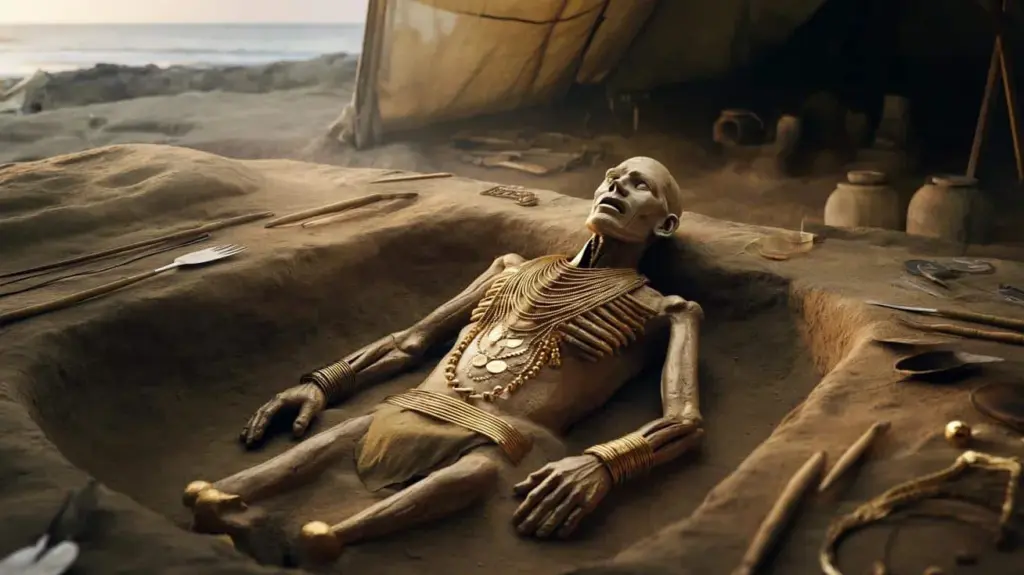
What began as an accidental discovery near the Bulgarian city of Varna in the 1970s has grown into one of archaeology’s most unsettling case files, raising hard questions about when humans first shaped gold, and when we first accepted stark social inequality as part of daily life.
The cemetery that shouldn’t exist
In autumn 1972, workers on the outskirts of Varna hit bones and pottery while leveling the ground. Archaeologists were called in, and the scale of what lay beneath their feet quickly became clear: an extensive prehistoric cemetery, later dated to between 4600 and 4300 BC.
Across some two decades of excavations, researchers uncovered nearly 300 graves. Sixty-two of them contained gold objects. For a community living thousands of years before the pyramids, the level of craftsmanship was astonishing.
More than 3,000 individual artefacts emerged from the soil:
- Fine necklaces made of gold beads
- Intricate bracelets and rings
- Delicate earrings and pendants
- Small discs once sewn onto clothing as shiny ornaments
Altogether, the finds weighed over six kilograms of solid gold. Radiocarbon dating places the cemetery around 6,600 years ago, making Varna the oldest firmly dated evidence of gold-working known so far.
Long before pharaohs and ziggurats, people by the Black Sea were already melting, hammering and shaping gold with surprising skill.
A tiny gold bead found in 2016 at another Bulgarian site might be slightly older, yet its age remains debated. Varna, by contrast, offers a dense, well-dated package of graves, goods and human remains that tie the story together.
Grave 43: the man wrapped in gold
Out of the hundreds of burials, one stands apart like a flare in the dark: Grave 43. This single tomb held nearly a third of all the gold found at the site.
Inside, archaeologists uncovered the skeleton of a man aged over 60, astonishingly old for the late Stone Age. He had been laid to rest with an inventory that reads almost theatrical: a copper axe with a handle covered in gold, heavy gold bracelets, multiple necklaces and dozens of decorative pieces placed on and around his body.
➡️ Warum Daten an mehreren Orten sichern Sie vor Ransomware-Angriffen retten kann
➡️ Wie der Staat den Mittelstand ausplündert und Reiche schont
➡️ Zur falschen Uhrzeit zu lüften kann Feuchtigkeit in der Wohnung einschließen und langfristig Probleme verursachen
➡️ Die Körpersprache-Geheimnisse, die helfen Respekt und Autorität an jedem Arbeitsplatz zu befehligen
➡️ Einfache Strategien, um in der Modeaccessoires Kombinationen zu variieren und Outfits zu personalisieren
➡️ Diese einfache atemtechnik lässt dich abends schneller abschalten doch viele experten warnen vor unterschätzten nebenwirkungen
➡️ Der schnelle Trick, der Schimmel entfernt, ohne Oberflächen zu beschädigen: „Ich habe es einmal ausprobiert und der Unterschied ist spektakulär“
➡️ Die küchenzutat die mattem grauem haar den glanz zurückgibt und warum friseure sie heimlich hassen
Then came the most puzzling object: a gold sheath designed to cover the penis. This is not a common item in prehistoric graves. In fact, nothing comparable has been securely identified elsewhere for this period.
The gold sheath has become the symbol of Grave 43: a direct, almost provocative marker of male status, sexuality and power.
Archaeologists still argue about this man’s role. Some suggest he may have been an accomplished metalworker, perhaps an early goldsmith whose skill earned him exceptional honours. Others point toward political or spiritual leadership, seeing him as a chieftain, priest, or a figure who combined both roles.
The Varna Archaeological Museum notes that only a tiny minority of individuals in the cemetery received anything close to this level of funerary wealth. In a community where most people were buried modestly, Grave 43 looks less like a respectful farewell and more like a glowing statement: this man mattered more than the rest.
First gold, first hierarchies
Why here, and why then? Around Varna and across the Balkans, this period marks the early Copper Age, when communities began exploiting metal ores in a more systematic way. The region was rich in copper and other resources, and local groups tapped into emerging trade routes stretching across southeastern Europe.
As mining and metalworking advanced, so did long-distance exchange. Exotic materials, tools and ornaments moved between villages. Not everyone had equal access to them.
Varna shows gold not just as decoration, but as a language of power, used to separate leaders from everyone else.
In many graves, simple ceramic vessels and stone tools accompany the dead. In a smaller group of tombs, gold and luxury items cluster around specific individuals, nearly all adult men. This uneven distribution points toward a stratified society, where rank and privilege were clearly recognised.
Was Varna an early “civilisation”?
Some researchers argue that the Varna community qualifies as an early centre of civilisation, predating the classic cradles like Egypt or Mesopotamia by many centuries. The term is controversial, yet the evidence is striking:
| Feature | What Varna shows |
|---|---|
| Social ranking | Lavish graves for a few, modest burials for most |
| Specialised skills | Advanced metalwork, fine ceramics, craft specialisation |
| Trade networks | Materials and objects suggesting far-reaching exchanges |
| Symbolic culture | Carefully arranged jewellery and ritual objects |
Seen together, these elements hint at organised authority and shared beliefs, not just scattered farmsteads.
Gold as a social technology
Gold is soft, rare and visually striking. It has no practical use for cutting or building. Yet at Varna, people invested enormous effort into extracting and shaping it.
For archaeologists, that choice speaks loudly. Gold acts like a social technology: a tool for sending messages about rank, identity and connections.
A few key roles gold may have played at Varna include:
- Marking leaders whose authority needed to be visible in life and in death
- Expressing alliances between families or groups through shared styles of jewellery
- Serving as portable wealth for trade, gifts or negotiations
- Acting as sacred or ritual material linked to ideas about the sun, immortality or the ancestors
The penis sheath, especially, pulls these themes together in an unsettling way. It ties male sexuality, fertility, authority and divine favour into one gleaming object, displayed on a body that would be seen by mourners before the grave was sealed.
What the grave says about everyday life
The dead do not bury themselves. Every object in Grave 43 reflects choices made by the living. Those choices point back to daily life around Varna:
Someone mined and smelted the gold and copper. Someone crafted the jewellery, possibly in a dedicated workshop. Others organised food production so that specialists could focus on metalwork and trade. The community had to accept that certain men, like the occupant of Grave 43, would receive a disproportionate share of prestige goods.
Behind the glittering artefacts lies a less shiny reality: unequal access to labour, resources and status.
This makes Varna a key reference site for researchers studying how early farming communities shifted from loosely organised villages to more rigid hierarchies.
Why archaeologists care about one grave so much
An individual burial like Grave 43 becomes a case study for broader questions on human behaviour. When did inequality start to feel “normal”? At what point did wealth and power start to pass from one generation to the next?
By comparing Varna to other sites along the Danube and in Anatolia, researchers can look for patterns: similar gold ornaments, shared burial positions, or repeated combinations of objects. Each pattern hints at alliances and cultural links across large areas.
For students or readers trying to follow this research, a few terms often appear:
- Necropolis: a planned cemetery area, often used over several generations.
- Grave goods: items placed in a burial, which may signal status, profession or beliefs.
- Social stratification: the layering of a society into ranks, where some groups hold more power and resources.
- Prestige goods: rare or demanding-to-make objects used to display influence rather than for practical tasks.
What this ancient gold says about us today
Standing in front of the reconstructed Grave 43 display in Varna’s museum, visitors often react less to the age of the objects than to their familiarity. A decorated leader, rich funerary display, unequal treatment in death: the pattern feels uncomfortably current.
Archaeologists sometimes run thought experiments based on Varna. Imagine two neighbouring communities: one that invests heavily in gold and status symbols, and another that spreads resources more evenly. The first may attract followers, traders and ambitious individuals seeking advancement. Over generations, its influence grows, reinforcing the very inequality that made it attractive in the first place.
Varna hints at how that spiral might begin. Gold did not create hierarchy on its own, but it offered a highly visible stage on which power could be performed, celebrated and remembered.
For anyone interested in early societies, the cemetery forces a blunt realisation: by the Black Sea, six and a half millennia ago, people had already started playing some of the games we still know today—competition for status, visual displays of success, and the urge to carry power with us, even into the grave.