
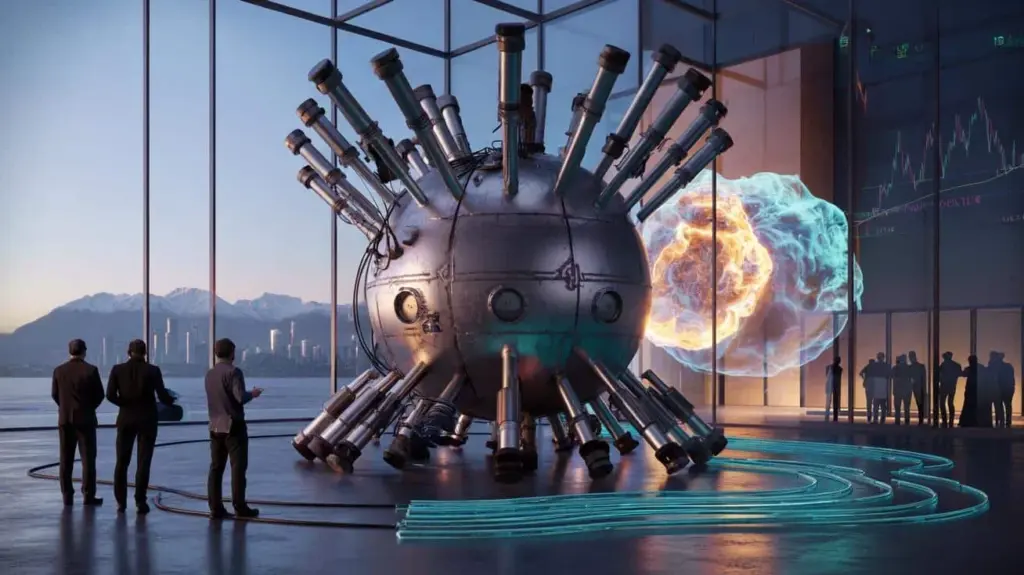
In Canada, a fusion start-up backed by deep-pocketed investors is preparing a move that could reshape how markets view nuclear fusion – and how quickly it reaches the grid.
Vancouver-based General Fusion is set to become the first “pure play” nuclear fusion company to list on a stock exchange, after agreeing a merger with a US special purpose acquisition company (SPAC), Spring Valley Acquisition Corp. The deal marks a turning point: fusion is no longer just a physics experiment tucked away in national laboratories, but an industry asking public investors for cash and scrutiny.
From lab bet to billion-dollar valuation
The transaction gives General Fusion a pro forma valuation of about $1 billion. That figure rests on two main money streams: roughly $110 million from an oversubscribed private fundraising, and around $240 million held by the SPAC, assuming investors keep most of their shares rather than pulling their cash.
The goal is blunt: fully fund General Fusion’s first full-scale demonstration machine, Lawson Machine 26, and prove that its unusual approach can actually work.
For fusion insiders, the listing is a symbolic moment. Up to now, Wall Street exposure to fusion has mostly come bundled inside big industrial groups or diversified tech funds. A public General Fusion share will effectively be a direct bet on commercial fusion power arriving within the next decade or two.
The move also sends a signal to rival start-ups and governments: Canada aims to be more than a passive host to foreign labs. It wants a home-grown player in the race to turn fusion into a bankable, regulated energy source.
A fusion reactor with pistons instead of magnets
Most fusion stories feature vast, torus-shaped machines wrapped in superconducting magnets, such as the ITER project in southern France, or laser cathedrals like the National Ignition Facility in California. General Fusion has taken a radically different route.
How the “diesel engine of fusion” works
The company’s core technology is called magnetized target fusion (MTF). The set-up looks less like a sci‑fi reactor and more like a heavy industrial machine. Around a spherical chamber filled with swirling liquid lithium, dozens of mechanical pistons slam inward in a carefully timed sequence.
Inside that sphere sits a blob of super‑hot plasma, already magnetised and pre‑heated. When the pistons fire, they create a pressure wave through the liquid metal, compressing the plasma for a split second to fusion conditions.
➡️ Der wirtschaftliche Lift von KI-Ausgaben-Surges und Aktien-Picks für diversifizierte Exposure
➡️ Wenn nachbarn über gemüse im vorgarten entscheiden wie eine harmlose idee ein ganzes dorf entzweit
➡️ Deutschland kürzt Sozialleistungen für Asylsuchende ab 2025
➡️ Schlechte Nachrichten für einen Rentner der einem Imker Land verpachtet hat er muss Landwirtschaftssteuer zahlen ich verdiene damit kein Geld eine Geschichte die die Meinungen spaltet
➡️ Fünf Abendrituale von Langlebigkeits-Experten, die Jahre hinzufügen, ohne große Umstellungen
➡️ Schlechte Nachrichten für einen Rentner der einem Imker Land verpachtet hat er muss Landwirtschaftssteuer zahlen obwohl er damit kein Geld verdient und warum diese Geschichte die Republik spaltet
➡️ This is the precise moment you must stop feeding garden birds, experts warn
➡️ Wenn elternchats zur digitalen hetztribüne werden wie whatsappgruppen an grundschulen eskalieren warum die schulnation vor einem erziehungsinfarkt steht und was wir gegen die neue bildungspanik tun können
No giant, cryogenic magnets. No stadium-sized lasers. Just fast, brutal compression from old‑school engineering hardware.
The liquid lithium shell plays two roles at once. It shields the steel structure from the intense neutron bombardment that would quickly destroy solid walls in more conventional designs. At the same time, it absorbs the fusion energy as heat, which can then be routed into a standard steam turbine loop.
That liquid wall is a big part of General Fusion’s pitch. Fusion reactors face a nasty materials problem: fast neutrons weaken even exotic alloys, forcing regular, expensive replacement. A constantly refreshed liquid layer sidesteps much of that wear, at least on paper.
Lawson Machine 26: a near‑commercial demonstrator
The centrepiece of the new fundraising is Lawson Machine 26 (LM26), the company’s full-scale demonstration device. It already exists and is being brought through staged operating milestones.
LM26 has a diameter that’s about half that of a future commercial power module. That makes it more than a physics toy; it is a testbed for real-world engineering issues like plumbing, maintenance, and integration with the grid.
General Fusion has laid out three key milestones for LM26:
- Reach 1 keV plasma temperature (around 10 million °C) to stabilise and characterise the plasma behaviour.
- Then push to 10 keV (around 100 million °C), where fusion reactions become frequent and meaningful.
- Finally hit the “Lawson criterion” – a specific combination of temperature, density, and confinement time needed for net energy gain.
These thresholds are standard landmarks in fusion research, but achieving them with pistons and liquid metal, rather than magnets and lasers, would be a major proof point for the MTF route.
Fusion treated as an industrial machine, not a physics stunt
Executives at General Fusion like to compare their future plants to diesel generators for the grid: rugged, repeatable, serviceable. The underlying idea is to lean on known mechanical engineering rather than pushing exotic physics to new extremes.
Rather than chasing perfect plasma confinement for hours, General Fusion aims for short, repeatable bursts running many times a second, wrapped in equipment that looks familiar to heavy industry.
In practice, that means trading some scientific elegance for engineering pragmatism. Pistons must fire at precisely the right moment. The lithium loop must handle continuous cycling, impurities, and corrosion. But the resulting power plant could be far smaller and simpler than a tokamak-based reactor, and possibly cheaper to build.
How General Fusion stacks up against other fusion concepts
General Fusion operates in a crowded field. Dozens of companies are trying to bottle fusion with very different toolkits.
| Confinement method | Core idea | Typical projects |
| Magnetic confinement (tokamak) | Doughnut-shaped plasma confined by huge magnetic fields | ITER, JET, EAST |
| Magnetic confinement (stellarator) | Twisted magnetic fields without current in plasma | Wendelstein 7-X |
| Inertial confinement (lasers) | Laser pulses crush tiny fuel pellets in nanoseconds | NIF, Laser Mégajoule |
| Magnetized target fusion (MTF) | Pre‑magnetised plasma squeezed by mechanical compression in liquid metal | General Fusion |
| Advanced magnetic concepts | Self‑organised plasmas with internal magnetic structures | Spheromaks, FRC start-ups |
Where some rivals, such as US-based Helion Energy, use electromagnetic pulses to compress plasma and promise direct electricity conversion, General Fusion centres its strategy on moving parts, hydraulic systems and heat extracted in a familiar way. For investors, that difference matters: it shapes both the technical risk and the future cost structure.
A changing energy backdrop lifts fusion’s prospects
The timing of General Fusion’s stock market move is not random. Global electricity demand is set to jump by 40–50% by 2035, according to the International Energy Agency, driven by electrification of heating and transport, hungry data centres and new industrial processes.
Renewables will provide much of that extra power, but grids will also need firm, low‑carbon capacity that can ramp up on demand. Existing nuclear plants fill part of that role, yet ageing reactors, high capital costs and political resistance limit rapid expansion in many countries.
Fusion holds out a tempting offer: carbon‑free, meltdown‑free baseload power, using tiny quantities of fuel, with relatively low long‑lived radioactive waste.
That promise explains why private funding for fusion has surged. Helion, backed by OpenAI’s Sam Altman, has raised roughly $400 million. Other companies, from UK-based Tokamak Energy to US firm Commonwealth Fusion Systems, are pulling in similar sums. General Fusion’s listing adds another channel for capital: retail investors and institutional funds that want direct exposure.
Key concepts and real‑world implications
What the Lawson criterion actually means
The Lawson criterion, named after British physicist John Lawson, is a practical yardstick. It says that for fusion power to make sense, three things must line up: the plasma must be hot enough, dense enough and confined long enough so that it produces more energy than you put in.
Each concept tackles this trade-off differently. Laser facilities use extremely high densities for incredibly short times. Tokamaks keep lower-density plasmas confined for much longer. General Fusion aims for a middle ground, relying on high pressure and moderate confinement time, repeated rapidly.
What a commercial Canadian fusion plant could look like
If General Fusion’s LM26 hits its targets and a first commercial unit follows, a plant might resemble a compact industrial building on the edge of a town rather than a sprawling nuclear site.
Picture a hall with several spherical fusion modules, each surrounded by tangle of pumps, heat exchangers and turbines. Truck deliveries of lithium and deuterium would be occasional and modest in scale. The site would still be heavily regulated, but safety zones could be much smaller than for today’s fission reactors.
Such plants could serve energy‑intensive customers directly: data centres, chemical clusters, or cities that struggle to build new transmission lines for distant wind and solar farms.
Risks, bottlenecks and what investors should watch
None of this is guaranteed. Fusion projects have a long history of delays and optimistic timelines. For General Fusion, several risks stand out.
- Engineering risk: Can hundreds of pistons fire in perfect synchrony, millions of times, without unacceptable failure rates?
- Materials and maintenance: Will the liquid lithium loop corrode pipes, or introduce impurities that damage performance?
- Economics: Even if net energy is reached, will the plant cost per kilowatt-hour beat advanced fission, geothermal or long-duration storage paired with renewables?
- Regulation and public acceptance: Fusion avoids many fission headaches, but still needs clear rules on tritium handling and radioactive components.
For Canada, there is also a strategic angle. A domestically listed fusion champion could attract high‑skill jobs, pilot plants and international partnerships. Yet it also exposes the sector to stock market moods. A few missed milestones could cool investor enthusiasm for fusion more broadly.
For readers trying to keep track of the alphabet soup of new energy acronyms, one practical tip stands out: watch not only who reaches flashy “ignition” moments, but who can repeat those results cheaply, safely and thousands of times per day. The race is no longer just about sparks in a lab, but about building machines that operators would trust on a rainy Tuesday afternoon in January.