
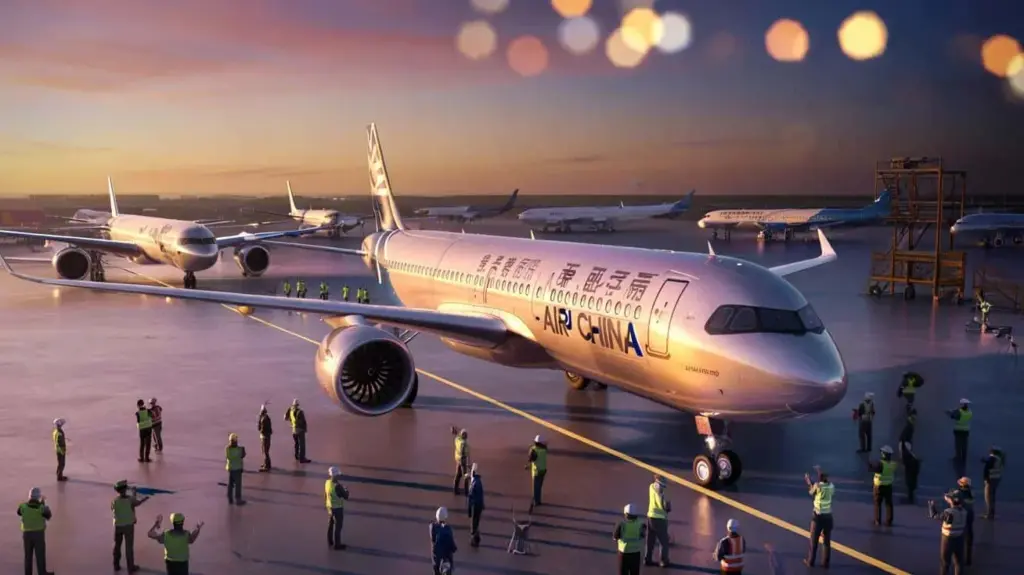
In Tianjin, Airbus and its Chinese partners have crossed a symbolic threshold that says a lot about who will really shape the future of global aviation.
China’s Tianjin plant hits 800th A320 as production ramps up
Airbus has delivered the 800th A320-family jet assembled at its Final Assembly Line Asia (FALA) in Tianjin, northern China. The aircraft, an A321neo for flag carrier Air China, marks a turning point in both Airbus’s industrial strategy and China’s rise as an aviation powerhouse.
Eight hundred A320-family aircraft built in China: Airbus now speaks fluent mandarin in industrial terms, not just in sales meetings.
The Tianjin line began operations in 2009. The first 500 aircraft took 11 years to roll out. The next 300 needed only about five years, underlining how sharply the pace has accelerated.
Since October 2025, a second assembly line has been running at the Tianjin site. The goal is simple: double throughput to keep up with demand from Chinese and wider Asian carriers.
That demand is huge. Industry forecasts suggest China alone will need more than 9,000 new aircraft by 2042, roughly one in four of all commercial jets expected to enter service worldwide by that time.
Where Airbus builds the A320: four continents, one best-seller
The A320 family – which includes the A319, A320 and A321, plus their latest-generation “neo” versions – is Airbus’s core product and the backbone of short- and medium-haul fleets worldwide. To keep up, the group has built a truly global industrial network.
| Site | Assembly lines | Country |
|---|---|---|
| Hamburg | 4 | Germany |
| Toulouse | 2 | France |
| Mobile (Alabama) | 2 | United States |
| Tianjin | 2 | China |
This spread gives Airbus three strategic advantages. It brings production closer to key customers, reduces currency and supply-chain risks, and helps secure political goodwill in major markets, from Washington to Beijing.
Tianjin started as a forward base in China. With 800 aircraft now delivered and a second line active, it has become a core pillar of Airbus’s global system.
➡️ Schlechte nachrichten für einen rentner, der einem imker land verpachtet hat: er muss landwirtschaftssteuer zahlen – „ich verdiene damit kein geld“ – eine geschichte, die die meinungen spaltet
➡️ Why you really should avoid buying fish between Christmas and New Year’s Eve
➡️ Rentner muss für verpachtetes land an imker landwirtschaftssteuer zahlen und fühlt sich betrogen eine geschichte die die gesellschaft spaltet
➡️ “I was always told to heat to 19°C”: why your idea of the ideal home temperature is probably wrong
➡️ Zehn Wege, ungenutzte Skills auf Plattformen wie Upwork inmitten 2025-Entlassungen zu monetisieren
➡️ Wie ein harmlos wirkendes schulprojekt zum thema gendersprache eine kleinstadt spaltet und eltern gegen lehrer aufbringt
➡️ Best bouchon lyonnais 2025″: here’s the address of this freshly crowned restaurant
➡️ A study reveals how much meat we can eat while keeping production sustainable
China: from booming market to indispensable partner
A domestic market that rewrites the forecasts
China’s air travel market is now the world’s most dynamic, edging ahead of the United States and Europe in growth potential. New airports open every year, regional cities gain international links, and a rising middle class is flying more often and farther.
Airbus projects passenger traffic in China will grow by about 5.3% annually over the next 20 years, against roughly 3.6% worldwide. That gap compounds quickly. Each percentage point means more aircraft, more routes and more pressure on manufacturers to deliver on time.
For Airbus, that reality makes Tianjin far more than an industrial showpiece. It is a bridge into long-term relationships with Chinese airlines and a way to anchor the brand inside the country’s supply chains and political priorities.
A 40-year Sino-European relationship
Airbus’s presence in China did not start with the first A320 parts arriving in Tianjin. The partnership stretches back four decades and has evolved from simple aircraft sales into deep industrial cooperation.
- Early technical cooperation and pilot training programmes
- Joint engineering projects and research centres
- Long-term contracts with Chinese suppliers for structures and cabin components
- Training academies and maintenance partnerships across several Chinese cities
Today, Chinese suppliers contribute to entire sections of Airbus jets, from fuselage parts to interior fittings. Local engineers work alongside European teams on process optimisation and quality control.
China is no longer just a buyer of Airbus aircraft; it is embedded in how those aircraft are designed, assembled and delivered.
A321neo: the quiet king of medium‑haul skies
Why this particular jet matters so much
The aircraft that tipped Tianjin past the 800 mark, an A321neo for Air China, is itself a symbol. The A321neo has become the best-selling single-aisle aircraft in the world, turning into Airbus’s star performer across multiple regions.
In dense layouts, an A321neo can carry up to around 244 passengers. In its forthcoming XLR variant, expected to enter service around 2026, it will be able to fly roughly 7,400 km. That kind of range lets airlines replace some widebodies on thinner long routes and open point-to-point services that were previously unprofitable.
Airbus says the A321neo family can cut fuel burn by up to about 20% versus older A321 models, thanks to new engines and aerodynamic tweaks. For airlines facing volatile fuel prices and climate scrutiny, those savings are not just nice-to-have; they shape fleet planning for decades.
By late 2025, the A321neo line had accumulated more than 5,600 orders, making up around 60% of all A320neo-family commitments.
Where the orders are coming from
Demand for the A321neo stretches across every major region:
| Region | Estimated orders | Key customers |
|---|---|---|
| Asia-Pacific | 1,600+ | IndiGo, China Southern, Jetstar, VietJet |
| North America | 1,300+ | Delta, American Airlines, JetBlue, Air Canada |
| Europe | 1,100+ | Lufthansa, Wizz Air, easyJet, British Airways |
| Middle East | 700+ | Qatar Airways, Saudia, flynas |
| Latin America & Africa | 500+ | LATAM, Avianca, Air Senegal |
| Total | 5,600+ aircraft | — |
China fits squarely into this pattern. Rapidly growing carriers such as China Southern, China Eastern and Air China see the A321neo as a flexible workhorse that can serve domestic trunk routes, regional hubs and even some long-haul segments from secondary cities.
China’s own aerospace ambitions are accelerating
COMAC and the push for home-grown aircraft
While it deepens its ties with Airbus, China is also building a parallel ambition: an indigenous commercial aircraft industry. The clearest example is the COMAC C919, a single-aisle jet designed to compete with the A320 and Boeing 737 families.
The C919 has now been certified in China and is flying with launch customer China Eastern Airlines. It still relies heavily on Western systems and engines, but the long-term objective is clear: reduce dependence on foreign manufacturers and develop a full domestic ecosystem.
Alongside the C919, the ARJ21 regional jet serves shorter routes, while Chinese engineers work on future domestic engines such as the CJ‑1000A to replace imported powerplants.
China is running a dual-track strategy: deepen cooperation with Airbus while quietly building rivals that may one day challenge it head-on.
Beyond airliners: research, materials and future concepts
China’s aerospace investment goes far beyond final assembly lines. Universities and research centres in cities like Xi’an, Chengdu and Shenyang are advancing work in composite materials, quieter and more efficient engines, and next‑generation air traffic management.
There is also money flowing into experimental sectors: electric air taxis for urban mobility, long-range supersonic concepts, and greener fuels. For Airbus, being present on the ground in Tianjin offers a front‑row seat for these developments and a chance to shape standards and partnerships early.
Why this milestone matters for travellers and airlines
Behind the industrial figures sit very concrete effects for passengers and airlines. More A321neos rolling out of Tianjin means Chinese and Asian carriers can modernise fleets faster, retire older jets and add direct services that skip traditional hubs.
An airline might, for example, replace a widebody on a lightly used Beijing–Vienna route with an A321XLR, cutting costs and emissions while keeping the service. Or a carrier in western China could launch direct flights to Southeast Asian holiday destinations with a narrowbody that offers range and comfort previously reserved for larger jets.
For travellers, that often means more direct routes, higher frequency and slightly lower fares on competitive markets. For airlines, it sharpens the race for efficient aircraft slots at a time when order backlogs stretch well into the 2030s.
Key terms and risks behind the headlines
Two expressions appear constantly in this story: “final assembly line” and “neo.” A final assembly line is the last stage of aircraft production, where fuselage sections, wings, engines and systems come together, are wired, tested and prepared for delivery. Most high-value engineering and component manufacturing happens upstream, but the assembly line is where logistics and quality must mesh flawlessly.
“Neo” stands for “new engine option.” On the A320 family, it refers to a generation of more efficient engines combined with aerodynamic refinements, which together cut fuel burn and CO₂ emissions compared with older “ceo” models (“current engine option”).
There are risks beneath the upbeat tone. Stretching production across continents makes Airbus more resilient but also more exposed to geopolitics. Trade tensions, export controls on advanced components or certification disputes could slow deliveries or complicate cooperation with Chinese entities. At the same time, the rise of COMAC adds long-term competitive pressure in the very segment that now underpins Airbus’s success.
For now, though, both sides seem to judge that mutual dependence brings more benefits than headaches: China gains high-skilled jobs, technology transfer and reliable capacity; Airbus secures its place in the fastest-growing part of the global aviation market, one A321neo at a time from its expanding Tianjin base.