
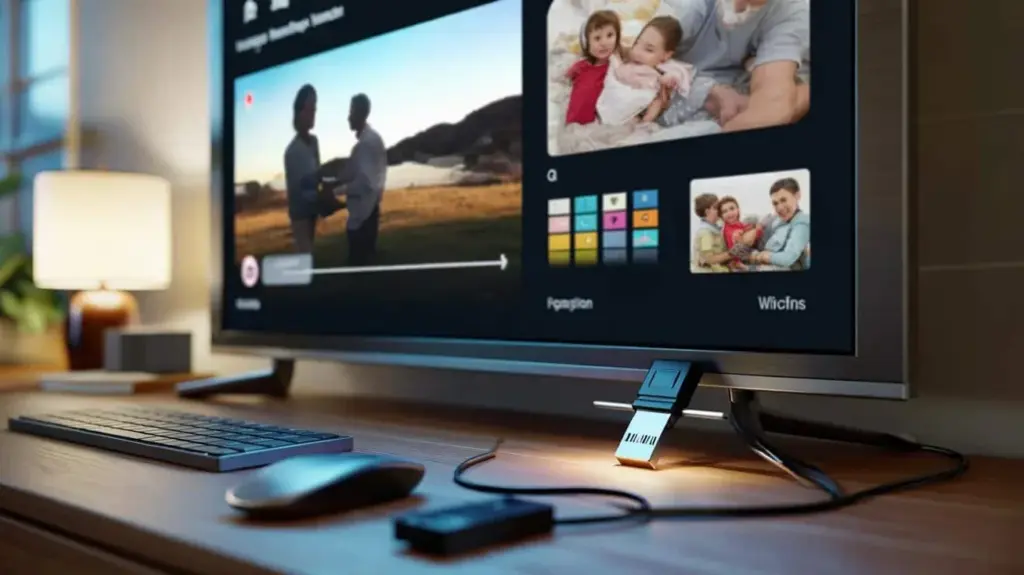
Most people ignore the USB port on their television, assuming it is there for technicians or software updates. In reality, it can turn a basic living-room screen into a far more flexible hub for media, work and gaming, with only a few inexpensive accessories.
Turn your TV into a mini recorder and storage hub
Modern TVs, even high-end models, often come with surprisingly limited internal storage. A few streaming apps and software updates, and the space is nearly gone. That is where the USB port becomes genuinely useful.
Plugging in a fast USB stick or external hard drive can give your TV the storage it never had from the factory.
On many sets, once a drive is connected, the TV offers to format it. This prepares the device for recording live channels, pausing programmes, or saving catch‑up content directly to that external storage.
Recording live TV with a USB drive
If your TV supports USB recording, you can treat it almost like a personal video recorder:
- Record live programmes while you watch another channel (on compatible models)
- Pause and rewind live broadcasts using “time‑shift” functions
- Store films, documentaries and sports events without filling the TV’s internal memory
For this to work smoothly, the type of drive matters. A slow, very old USB stick may struggle with high‑definition video. A USB 3.0 flash drive or an external SSD usually gives smoother recording and faster navigation through content.
Some brands encrypt recordings so they can only be played back on the TV that created them. That can be frustrating if you expect to move files to a laptop, so checking the manual before buying a large drive is worth the trouble.
Creating a simple media centre
Once a sizeable USB drive is connected, the TV can serve as a basic media centre. You can:
- Store a personal collection of films and series
- Keep downloaded podcasts or radio shows to play through the TV speakers
- Organise folders by genre, family member or language
Several manufacturers now auto‑detect new storage and add it to their media browser. That makes browsing files feel closer to using a streaming app than a clunky file manager.
➡️ Shein, Temu, Aliexpress: why you’ll now pay more for all your orders from Chinese platforms
➡️ Living in this French city in 2030 could be far harder than you think: start planning your move
With a decent USB drive, an ordinary TV begins to behave like a stand‑alone media box, with no extra set‑top hardware.
Use a keyboard, mouse or gamepad for a smarter TV experience
Smart TVs promise apps, web browsing and productivity tools, yet typing with a remote is painful. The USB port opens the door to a much more practical setup.
Typing and browsing without the remote struggle
Most TVs accept USB keyboards and mice. Plug them in, wait a few seconds, and you can type into search bars, log into streaming services, and navigate menus as if you were on a basic computer.
This is handy when you:
- Search YouTube or Netflix for specific titles or niche topics
- Write emails or messages via webmail on the big screen
- Use cloud office suites to read or lightly edit documents
Wireless sets that use a USB dongle also work in many cases. That lets you keep the sofa clear of cables while still controlling the TV with a proper keyboard on your lap.
Transforming your TV into a casual games console
Gamers can plug in USB controllers or adapters to play without buying a dedicated console. Several smart TV platforms support game streaming services like GeForce Now or Xbox Cloud Gaming, along with lightweight native games.
A USB gamepad gives you:
- More precise control than a standard remote
- A familiar layout for console‑style titles
- Enough comfort for longer sessions of racing, platform or sports games
Combined with cloud gaming, a simple USB controller can turn the TV into the main games machine in the house.
Lag and Wi‑Fi quality still matter, of course, but the USB port removes at least one barrier: no proprietary dongles or specialist hardware are required on many models.
Show photos and home videos on the big screen
The USB socket is also ideal for personal media. Rather than passing a phone around the living room, you can put your latest photos and clips onto a flash drive and plug it straight into the TV.
Most modern sets automatically scan the drive for compatible files and present simple galleries. You can usually sort or jump between folders directly with the remote.
Perfect for family gatherings and events
Displaying personal content this way works well for:
- Birthday parties and family dinners, with a looping slideshow in the background
- Holiday recaps, sharing travel photos and short clips on a larger screen
- Wedding or anniversary celebrations, with curated albums and old footage
Some TVs add extra flair: transitions, adjustable slide duration and background music from another folder on the same USB drive. That turns a simple slideshow into something closer to a curated presentation.
For people who rarely print photos, the TV’s USB port offers a low‑effort way to bring digital memories back into the living room.
Expand storage for more apps and services
Streaming apps keep growing in size, and TV manufacturers often install new features through updates. With only 8 or 16 GB of internal space, many sets quickly run out of room.
A USB drive can act as an extension, letting you keep more apps without constant pruning.
Moving apps to external storage
On some smart TV systems, you can move apps or part of their data to a USB device. That frees internal memory while keeping your favourite services installed. The TV sees the drive almost as if it were extra internal storage.
| Use case | Benefit of USB storage |
|---|---|
| Heavy streaming app usage | Install more platforms without uninstalling others |
| Casual gaming from app stores | Store larger games and updates outside the TV’s tiny memory |
| Frequent software updates | Reduce “not enough space” warnings and failed installs |
Performance still depends on the speed of the drive, so many manufacturers recommend a USB 3.0 stick or SSD if you plan to install apps on it. Cheaper, slow drives may cause freezing or longer loading times.
Key technical points and small risks to keep in mind
Using the USB port is usually safe and straightforward, but a few details deserve attention.
- File systems: Some TVs only read FAT32, which limits individual file size. Others support exFAT or NTFS, which handle larger 4K video files.
- Power limits: The USB port might not supply enough power for certain large hard drives. A drive with its own power supply is often more reliable.
- Data loss risk: Removing a drive while the TV is recording or writing can corrupt files. Using the on‑screen “eject” option helps avoid that.
There is also a privacy angle. If you record shows or store personal photos on a USB drive, treat it as you would a laptop: set a habit of unplugging and storing it safely when guests or children use the TV.
Practical scenarios where the USB port shines
Consider a small flat with no space for a full media cabinet. A single 256 GB USB stick in the back of the TV can quietly host:
- Downloaded films and offline series for nights when the broadband acts up
- Backups of home videos that are also saved in cloud services
- Additional apps for language learning, fitness or kids’ content
Or picture a student who uses the TV as a monitor. A USB keyboard and mouse turn the smart TV interface into something close to a lightweight desktop, useful for basic work tasks or online courses.
For families on a budget, these tricks postpone the need to buy extra gadgets. Instead of adding a streaming stick, a new console or a separate media box, they can push more life out of the TV they already own, simply by putting that overlooked USB port to work.