Instead, one towering animal’s twisted silhouette stopped everyone in silence.
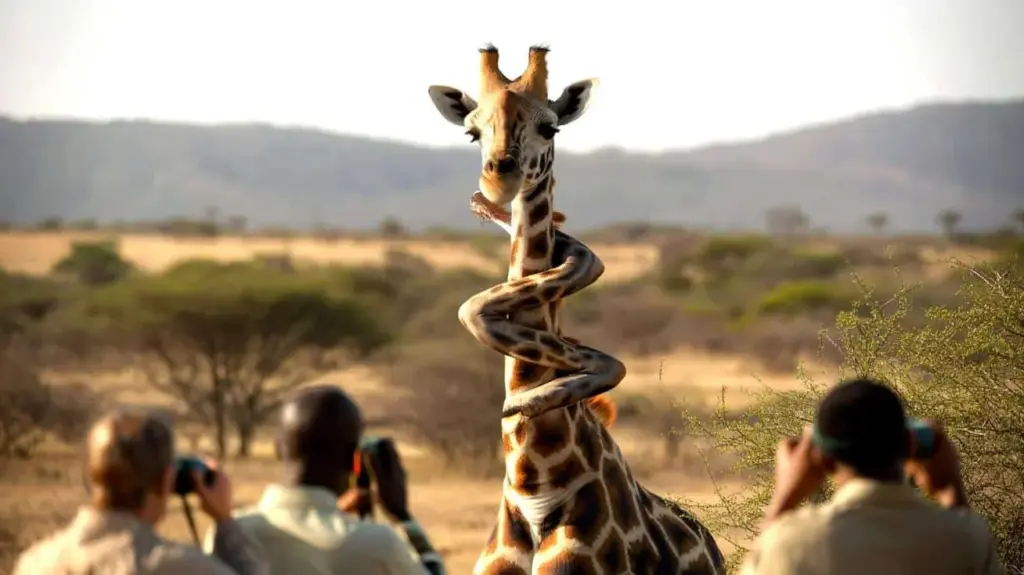
The giraffe, standing among low acacia trees, looked familiar from a distance. As binoculars focused, its neck revealed a dramatic zigzag bend that left visitors, guides and later scientists wondering how it was even alive.
A zigzag neck that shouldn’t be possible
The animal was photographed near South Africa’s famous Kruger National Park by travel blogger Lynn Scott, who shared the images online in early July. The pictures show an adult giraffe with its neck sharply kinked in at least two places, forming an angular S-shape instead of a smooth curve.
This is not a minor kink: the neck appears to fold on itself, creating a striking zigzag line between the shoulders and the skull.
Witnesses reported that the giraffe moved very little. It seemed able to stand and slowly shift its weight, but turning its head or browsing high branches looked extremely difficult. That unusual stillness raised immediate questions about pain, mobility and long‑term survival.
What a “normal” giraffe neck is built to do
To understand why this case is so unusual, researchers first point to how a typical giraffe neck functions. Despite its length, it is built from the same number of vertebrae as a human neck: seven. The difference comes from scale. Each vertebra can be over 25 centimetres long, stacked into a column that lets giraffes reach foliage more than five metres off the ground.
Giraffes use that height advantage to browse leaves, especially from acacia trees, with the help of a tongue reaching up to 45 centimetres. Their bodies are just as extreme: females often weigh around 800 to 1,200 kilograms, and large males can approach 1,800 kilograms.
They live in loose, shifting groups, often drifting between small herds over large areas of savannah. In the wild, a healthy giraffe can live about 25 years, slightly longer in captivity where predators and drought are controlled.
Necks built for combat, not for bending
A giraffe’s neck is not only for feeding. Male giraffes use it as a weapon. During fights known as “necking”, they swing their heavy heads like sledgehammers, smashing into a rival’s ribs or neck. These blows can reach dangerous force.
Most fights end with bruising and one male backing off. Occasionally, the violence escalates. In rare cases, scientists suspect that these clashes can fracture vertebrae or damage ligaments, permanently reshaping the neck.
➡️ Wie eine kleine gewohnheit nach dem aufstehen deinen fokus und deine motivation im januar zerstört und warum du trotzdem nicht damit aufhören wirst
➡️ Schlechte Nachrichten für einen Rentner der einem Imker Land verpachtet hat er muss landwirtschaftssteuer zahlen obwohl er nichts daran verdient und viele fragen sich ob das gerecht ist
➡️ Why blackbirds turn their backs on bird feeders when the cold hits (and how to feed them properly in winter)
➡️ Die zukunft verteilt erfolg und wohlstand an wenige sternzeichen „und wir gehen leer aus“ eine botschaft die neid und spaltung schürt
➡️ Wie aus deinem zuhause eine kalte renditemaschine wird wenn gierige vermieter mieter bis zum letzten cent auspressen
➡️ Milliardenschwerer energieversorger dreht kleinbetrieben den strom ab während chefboni steigen „das ist freie marktwirtschaft“ eine geschichte die die meinungen spaltet
➡️ Wie influencer unsere kinder vergiften warum energydrinks auch ohne alkohol zur sucht führen und weshalb die lebensmittelindustrie das risiko bewusst verharmlost
➡️ Schlechte nachrichten für alle die im homeoffice arbeiten wollen warum chefs ihnen nicht trauen und was das über unsere arbeitskultur verrät
The same structure that lets males fight for mates can, under extreme stress, become a point of catastrophic failure.
What could cause such a dramatic deformity?
Experts who reviewed the Kruger photographs, including conservation specialists such as those at the Giraffe Conservation Foundation, point toward one likely diagnosis: severe torticollis. In humans, torticollis is a condition where the neck muscles contract or the spine misaligns, causing the head to twist and tilt abnormally.
In wild animals, torticollis can stem from several problems, including:
- spinal infections affecting the neck
- congenital malformations present from birth
- healed or unhealed fractures of the cervical vertebrae
- nerve damage in the neck or upper spine
Without X‑rays or direct examination, no one can say exactly what happened to this giraffe. Specialists suspect either an old fracture that healed badly or a serious soft‑tissue injury that pulled the neck out of alignment.
Previous cases hint at violent origins
The Kruger giraffe is not the first animal with such an abnormality to be reported, but the severity appears unusual. In 2015, wildlife observers documented an adult male giraffe in Tanzania’s Serengeti National Park with a crooked neck. That animal was believed to have broken its neck during a fight with another male, then survived with a permanently deformed spine.
Records from zoos also mention occasional neck deformities in captive giraffes, though usually less extreme than the sharp zigzag seen in South Africa. In many of those cases, the animals adapted surprisingly well, adjusting their feeding posture and movement patterns.
| Case | Location | Suspected cause |
|---|---|---|
| Kruger giraffe (2024) | South Africa | Severe torticollis or old neck fracture |
| Serengeti male (2015) | Tanzania | Neck fracture during combat |
| Captive giraffes (various years) | Zoos, global | Congenital issues or injuries |
How does a giraffe live with a broken or twisted neck?
For an animal that depends on height, any problem in the neck is serious. A bent spine can interfere with feeding, making it harder to reach high foliage. It may also affect balance and the ability to run, leaving the giraffe more vulnerable to lions and spotted hyenas.
Yet some deformed giraffes have managed to survive for months or even years. They adjust their behaviour, browsing on lower shrubs or relying on areas with dense, accessible vegetation. Herd behaviour can also help: a group is more likely to detect predators early than a lone animal.
Adaptation in the wild is rarely neat. An injured animal survives if the landscape, predators and sheer luck line up in its favour.
One concern is chronic pain. A twisted neck can compress nerves, strain muscles and change how weight is carried through the shoulders and spine. Scientists can only guess how much suffering an individual giraffe endures, because assessing pain in wild animals at a distance is complex and often uncertain.
Why scientists care about a single injured giraffe
On the surface, this might look like a sad but isolated case. For biologists, it opens a set of useful questions about resilience, adaptation and conservation.
By tracking such individuals, researchers can learn:
- how long severely injured giraffes survive in different habitats
- whether they can still reproduce and care for calves
- which behaviours change most: feeding, movement, social contact or vigilance
- whether certain landscapes help them cope better than others
These insights can feed back into management plans. If some habitats let injured animals function more easily, similar conditions could be favoured in protected areas. For captive populations, understanding neck injuries can improve enclosure design, veterinary care and breeding decisions.
Conservation background: a tall icon under pressure
Giraffes often appear in travel brochures as abundant safari favourites. Field data tells a different story. Across Africa, giraffe numbers have dropped over recent decades in many regions, driven by habitat loss, poaching for meat and skin, and expanding farmland.
Different giraffe species and subspecies face different levels of risk, but several are now classed as vulnerable or endangered. Kruger and other major parks offer some of the safest remaining habitats, making unusual cases like this one more visible to tourists and scientists.
What “torticollis” actually means outside medical textbooks
The term torticollis may sound technical, yet people encounter mild versions more often than they realise. A stiff neck after sleeping awkwardly or a child born with a head tilt both fall under the same broad label.
At its core, torticollis describes an abnormal twisting or tilting of the head and neck. In humans, causes range from muscle spasms to nerve damage. In a giraffe, the problem scales up dramatically. A small misalignment can turn into a physical barrier to feeding, walking or fighting.
Veterinarians treating captive giraffes sometimes combine pain relief, physiotherapy and, in rare cases, surgery. For wild animals, such interventions are usually impossible. Sedating a one‑tonne animal with a fragile neck carries its own risks, and constant medical attention in open savannahs is not feasible.
What this tells us about wild animals and visible deformities
Sightings like the Kruger giraffe also shape how visitors think about wildlife. People on safari often expect perfect, postcard animals: spotless cheetahs, flawless elephants, elegant giraffes. Reality is messier. Wild populations include limping lions, blind antelopes and, occasionally, a giraffe with a zigzag neck.
From a scientific angle, these individuals are part of a broader picture. They show how far a body can be pushed and still function. They highlight the role of chance injuries, not only genetics, in shaping animal lives. They also remind researchers that survival is not a simple yes‑or‑no outcome but a sliding scale of coping, adapting and, sometimes, failing.
For visitors, guides often use such rare sightings as teaching moments. They can talk about how predators target vulnerable animals, how ecosystems recycle every carcass, and why protected areas need enough space and diversity to absorb shocks, whether they come from drought, disease or a single freak injury.