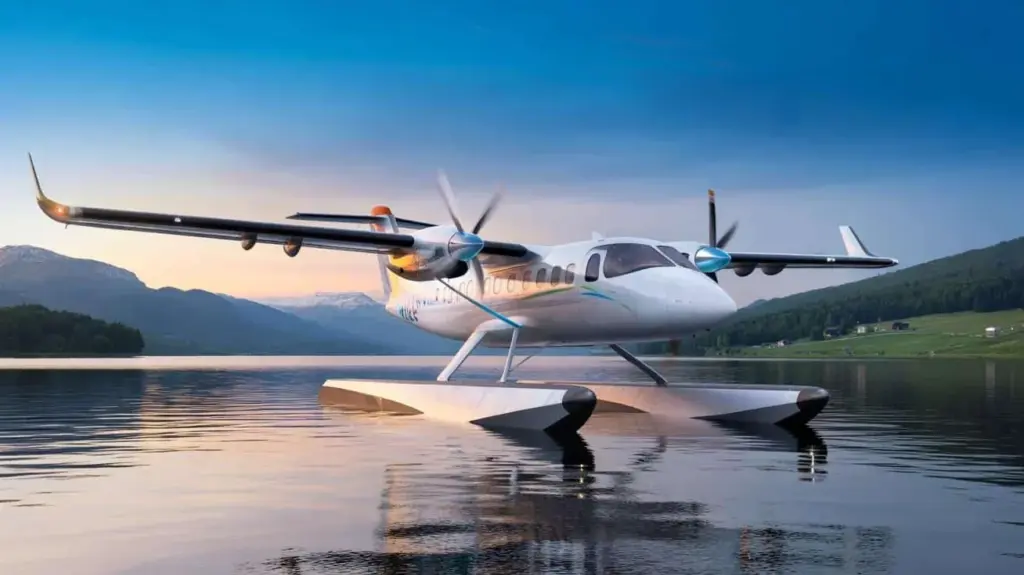
While most airlines still burn kerosene, a small startup near Lyon is betting on a radically different machine: a fully electric, 19‑seat regional aircraft that sips just a fraction of the energy of today’s planes and can even take off from lakes and rivers.
A regional airliner built around the climate crisis
Global aviation faces mounting pressure to cut CO₂ and other warming effects such as contrails. Airlines talk about sustainable aviation fuel, new routes and smarter traffic control. Yet the basic recipe remains the same: long, metal tubes powered by fossil fuels.
French startup Eenuee wants to rewrite that recipe from the ground up. Founded in 2019 in Saint‑Étienne, the company is developing Gen‑ee, a 100% electric regional aircraft designed for short hops of up to 500 kilometres. The aircraft is targeted at 19 passengers, a size that fits thin regional routes and charter operations.
Gen‑ee’s designers claim the aircraft will use around eleven times less energy than a conventional regional plane on the same mission.
The company has just signed a strategic partnership with Duqueine Group, a major composites specialist, to accelerate development. The first flight is slated for 2029, with certification under the European CS‑23 category, which governs small aircraft up to 8.6 tonnes at take‑off.
Why a “decarbonised” regional plane still matters
High‑speed rail captures headlines, and urban transport networks keep expanding. Yet many regions in Europe and beyond remain poorly served. Mountainous areas, remote coastal communities and sparsely populated regions often cannot justify the cost of big airports or frequent jet services.
Local authorities still need fast links for business, medical evacuation and tourism. Budgets are tight, and large infrastructure projects are politically difficult. This is the gap Eenuee is aiming at: small aircraft, low operating costs, minimal new infrastructure.
The promise is simple: light, quiet aircraft that use existing airfields, consume far less energy and run on electricity instead of fuel.
Because Gen‑ee will not require pressurised cabins or long paved runways, the startup argues that communities could restart or expand regional air links without building new airports or long rail lines.
➡️ Darum sollten Sie vor dem Sommerurlaub ein Glas und Papier ins Spülbecken legen
➡️ Schlechte Nachrichten für Mieter mit ölheizung die ihre nebenkosten senken wollen sie halbieren mit einem simplen trick ihre energiekosten und ruinieren gleichzeitig die klimapolitik ihres mietshauses was ihre nachbarn in zwei verfeindete lager spaltet
➡️ Schlechte nachrichten für käufer von stromfressern warum der moderne airfryer im heimlichen energiecheck plötzlich besser abschneidet als der klassische backofen und was das über unseren irrwitzigen stromverbrauch im alltag verrät
➡️ Wie ein stiller volksentscheid verschleiert wurde warum ihre strompreise weiter steigen und welche lobby dahinter steckt
➡️ Rentner weigert sich für an imker verpachtetes land steuern zu zahlen und entfacht eine erbitterte schlammschlacht mit finanzamt nachbarn und familie
➡️ Warum die heizkosten explodieren obwohl sie weniger verbrauchen und was die politik ihnen verschweigt
➡️ Mieter gegen investoren wenn luxussanierung das viertel spaltet und niemand die folgen tragen will
➡️ Wenn aus deinem zuhause eine kalte renditemaschine wird wie gierige vermieter mieter auspressen bis zum letzten cent
A blended wing body that carries its own weight
From metal tube to lifting fuselage
The most striking feature of Gen‑ee is its shape. Instead of the usual cigar‑shaped tube with separate wings and tail, the aircraft uses a “blended wing body” (BWB) with a lifting fuselage. Seen from the side, the body looks more like a wing than a tube.
In a conventional design, the wings do most of the lifting while the fuselage mainly adds drag. In a lifting fuselage configuration, the central body itself generates a significant share of lift. The transition between fuselage and wings is smoothed out, which reduces drag.
Control surfaces also change. Rather than a tailplane with elevators, Gen‑ee uses “elevons” on the trailing edge of the wing, a layout more common on some military aircraft. That makes the flight controls more complex to design and test, but offers better aerodynamic efficiency.
The team reports a lift‑to‑drag ratio of 25, far above many current regional aircraft, which translates directly into lower energy use.
Lightweight structure and no pressurisation
To hit its performance targets, Eenuee relies heavily on carbon‑fibre composites and high‑performance aluminium. Composites allow the curved shapes needed for a blended wing body while keeping the structure light and stiff.
Crucially, the Gen‑ee cabin will not be pressurised, which slashes structural weight and simplifies maintenance. The projected maximum take‑off weight is around 5.6 tonnes, well below the 8.6‑tonne upper limit of its certification class.
Every kilogram saved matters. A lighter aircraft needs smaller batteries to fly the same distance. Smaller batteries then further cut weight, creating a virtuous circle that helps offset the traditionally heavy nature of electric propulsion.
How an all‑electric regional plane reaches 11× efficiency
Three pillars of performance
According to the engineers, the 11‑fold energy advantage comes from three main factors:
- Aerodynamics: The blended wing body and lifting fuselage reduce drag, boosting aerodynamic efficiency.
- Propulsion chain: Electric motors and power electronics can reach efficiencies near 90%, far better than combustion engines.
- Mass: A lighter airframe, unpressurised cabin and optimised structure reduce the energy needed for each flight.
Conventional regional turboprops lose large amounts of fuel energy as waste heat in their engines. Electric systems convert a much higher share of stored energy into thrust, provided the batteries have enough capacity for the mission.
Instead of burning fuel at 30–40% efficiency, Gen‑ee aims to use battery energy far more directly, with fewer conversion losses.
The battery question and realistic range
The 500‑kilometre target range reflects current and near‑term battery technology. That distance covers many regional routes: Lyon to Nice, Oslo to Bergen, or seaplane hops between Canadian coastal towns.
Battery packs will still weigh much more than an equivalent load of kerosene. This is why the aerodynamic gains and mass reduction are so central. The design tries to claw back every watt through careful optimisation, rather than hoping for a miracle battery.
From runway to river: a multisurface aircraft
Hydrofoils instead of classic floats
Eenuee plans a version of Gen‑ee that can operate from lakes and rivers as well as airfields. Instead of traditional seaplane floats, the aircraft would use hydrofoils: underwater wings that lift the hull out of the water as speed increases.
Hydrofoils cut drag in the water far more than simple floats. Once the aircraft skims on the foils, take‑off resembles a departure from a runway. This concept is already proven in high‑performance sailing, and the engineers aim to adapt it to aviation.
A single machine that can fly from both runways and water could serve regions with very limited infrastructure and high distances between communities.
Compared with classic floatplanes, the hydrofoil approach also promises lower maintenance costs and better efficiency, since the aircraft does not spend its entire life dragging bulky floats through the air.
Potential markets across three continents
This “multisurface” capability opens up markets far beyond France. The company points to Scandinavia, Canada and parts of Asia, where communities depend on boats, helicopters or small seaplanes for transport.
A quiet, all‑electric aircraft able to use short runways or lakes could provide scheduled services, cargo and medical flights without new ports or big terminals. The focus is on operating from existing small aerodromes and natural bodies of water.
| Feature | Conventional regional plane | Gen‑ee concept |
|---|---|---|
| Energy source | Jet fuel / kerosene | Electric batteries |
| Seats | Typically 19–70 | 19 |
| Range | 500–1,500 km | ≈ 500 km |
| Take‑off weight | Up to ~8.6 tonnes (CS‑23) | ≈ 5.6 tonnes |
| Operating surfaces | Runways only | Runways plus water (hydrofoils) |
From scale models to certification
Ambitious design alone does not get an aircraft into the air. Eenuee is running a series of risk analyses, digital simulations and physical tests with scale demonstrators. Current models fly at 1:7 scale, with a 1:4 demonstrator planned next.
These tests help the engineers spot stability issues, refine the hydrofoil configuration and adjust structural details before committing to a full‑size prototype. The company aims to launch the formal certification process and Design Organisation Approval around 2027, in close contact with European regulators.
On the ground, the infrastructure plan remains modest: passenger handling facilities at small aerodromes, a handful of maintenance centres and charging systems similar, in concept, to those used for electric cars and ground vehicles. Large‑scale grid upgrades would mainly fall to public authorities and airport operators.
What “SAF”, “CS‑23” and other jargon really mean
Much of the debate around cleaner aviation uses dense jargon. Three terms matter here.
- SAF (Sustainable Aviation Fuel): Liquid fuel made from biomass, waste or synthetic processes instead of crude oil. It can often be used in existing engines but still produces CO₂ when burned, though with lower net lifecycle emissions.
- CS‑23: A set of European airworthiness rules for small aeroplanes. It defines safety requirements for structures, systems, performance and handling for aircraft up to a certain size.
- Blended wing body: A layout where the fuselage and wings form a continuous lifting surface, reducing drag and spreading lift across the whole airframe.
Understanding these terms helps clarify why Eenuee’s project is different from simply retrofitting a battery pack into an existing airframe. The entire aircraft is built around electric propulsion and regional missions.
Risks, use cases and what happens if it works
Electric aviation still faces clear risks. Battery technology might progress more slowly than hoped. Certification rules for novel shapes and hydrofoils may evolve in unexpected ways. Financing full‑scale production is always a hurdle for small aerospace firms.
Yet if Gen‑ee or a similar aircraft reaches commercial service, day‑to‑day impacts could be very tangible. A 300‑kilometre trip between two secondary cities could shift from a three‑hour drive to a one‑hour electric flight, without the climate cost of burning fuel. Remote clinics could receive doctors or supplies by air without the noise and emissions of helicopters. Humanitarian missions might move small cargoes into poorly connected regions using a quiet, low‑maintenance aircraft.
Even partial success would send a signal: that regional air travel does not have to be bound to kerosene, and that unconventional shapes once deemed “impossible” might start to look like the new normal.