
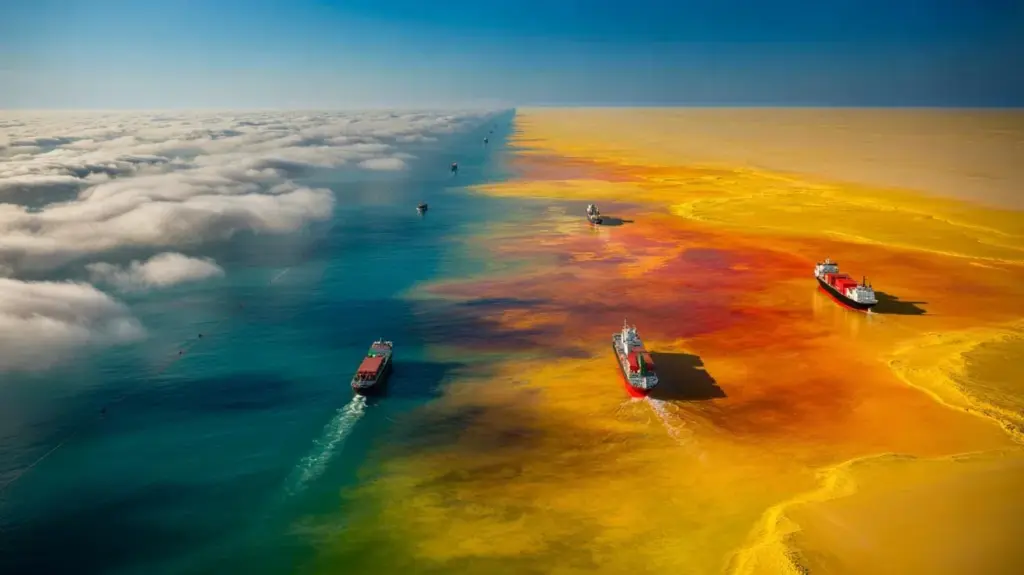
The ocean has smashed one temperature record after another, reshaping weather patterns from Europe to the Americas. While greenhouse gases remain the underlying driver, a French researcher now argues that a recent change in air pollution rules over the seas has sharply amplified the Atlantic’s heat spike.
A climate puzzle that startled researchers
By 2023, the average surface temperature of the North Atlantic was so high that the usual lines on climate charts suddenly looked outdated. The curve for that year sat clearly above previous records, almost like a separate climate era.
For years, scientists have warned that the oceans are quietly absorbing the bulk of human-made heat. One estimate for 2020 alone reached around 20 sextillion joules of heat stored in the oceans, an amount that defies everyday intuition. Yet the recent jump since 2020 has puzzled specialists because it goes beyond what existing climate models predicted for such a short period.
Greenhouse gases set the stage for long-term warming, but a rapid shift in ship pollution appears to have turbocharged the recent Atlantic surge.
This is where the work of a French researcher gains attention. By linking satellite observations, ship traffic records and climate simulations, he argues that cleaner fuel regulations for maritime transport unexpectedly removed a protective, cooling veil from above the Atlantic.
Cleaner ships, hotter ocean
From 2020, strict international rules forced most large cargo ships and tankers to cut sulfur content in their fuel dramatically. The goal was clear: reduce deadly air pollution and acid rain. According to recent estimates, sulfur emissions from ships above the oceans dropped by around 80% in just a few years.
That change did not only clean the air that port cities breathe. It also altered how much sunlight reaches the ocean surface.
How sulfur once shielded the Atlantic
Burning high-sulfur fuel releases tiny particles known as aerosols into the atmosphere. These particles help form bright, reflective clouds over major shipping routes, especially in the North Atlantic. Those clouds bounce part of the Sun’s rays back into space, cooling the surface below.
With new regulations, the number of these particles plummeted. Fewer reflective clouds formed along the busy transatlantic corridors between Europe, West Africa and the Americas.
➡️ Wenn der kampf fürs klima zur schlacht um die heimat wird und ein windpark das vertrauen in grüne energie zerstört
➡️ Junge mutter soll wegen behördenfehler kindergeld zurückzahlen und bringt das ganze viertel gegen sich auf
➡️ Ein geplanter windpark spaltet eine ganze region und macht aus nachbarn erbitterte gegner die von verrat an der heimat sprechen
➡️ In the desert, they are building an “artificial sun” to power cities
➡️ Schlechte nachrichten für einen rentner der einem imker land verpachtet hat er muss landwirtschaftssteuer zahlen ich verdiene damit kein geld eine geschichte die die meinungen spaltet
➡️ Rentner gegen finanzamt wegen steuern für land an imker
➡️ A giraffe with a strange neck in South Africa baffles scientists
➡️ Airfryer fan oder backofen purist warum der wahre stromfresser in deiner küche für heftige debatten sorgen wird
Removing ship-borne sulfur cleared the sky, letting more solar energy pour into the Atlantic just as the planet was already running a fever.
The French researcher’s analysis suggests that this “unmasking” effect might account for a noticeable fraction of the recent marine heatwave in the Atlantic. Climate models that include the aerosol drop reproduce a stronger warming spike than models that ignore the shipping rules, lending support to his argument.
A perfect storm of warming forces
The shipping factor does not act alone. Several elements likely lined up at the same time to push the Atlantic into uncharted temperature territory.
- Long-term greenhouse gas buildup trapping more heat in the climate system.
- The shift to an El Niño phase in the Pacific, which can subtly alter global weather and ocean circulation.
- Natural variability in Atlantic currents and winds on decadal scales.
- The sharp reduction in reflective aerosols from maritime traffic.
Rather than a single culprit, researchers describe a stack of influences. The French work stands out by quantifying one layer that had received less public attention: the loss of the cooling shield from ship pollution.
What the data shows in the North Atlantic
Satellite instruments now monitor sea surface temperature with striking precision. Over the North Atlantic, they reveal persistent patches of exceptionally warm water since 2020, stretching from the subtropics toward Europe.
Those warm patches align closely with historic shipping corridors. At the same time, satellite images show fewer bright “ship-track” clouds than in previous decades, consistent with lower sulfur emissions.
| Factor | Change since 2020 | Effect on Atlantic |
|---|---|---|
| Ship sulfur emissions | Roughly −80% above oceans | Less reflective cloud cover, more solar heating |
| Greenhouse gases | Continued rise in CO₂ and methane | Higher background temperature of air and water |
| El Niño–Southern Oscillation | Shift toward El Niño | Changes in winds and heat distribution globally |
| Natural variability | Short-term swings | Can amplify or dampen warming for a few years |
From marine heatwave to real-world consequences
Warmer Atlantic waters are not just a curiosity for climate charts. They shape daily life across several continents.
Hotter seas feed more intense marine heatwaves, stressing fish stocks and coral habitats. Some species shift northward in search of cooler water, disrupting traditional fisheries and coastal economies.
On land, the Atlantic’s warmth changes how storms grow. Hurricanes and tropical storms in the Atlantic draw their energy from surface heat. Warmer water can increase their potential for rapid intensification and heavy rainfall, even if other factors such as wind shear still modulate each storm.
For Europe, a warmer Atlantic often links to sticky summer heat, stronger downpours and unusual winter storms that ride in from the ocean.
Scientists are now watching whether the recent surge in Atlantic heat might also influence the Atlantic Meridional Overturning Circulation, a major system of currents that transports warm water north and cold water south. The current research does not claim that ship pollution rules directly threaten this circulation, but the added heat could interact with long-term trends in salinity and density.
Why reducing pollution can briefly speed up warming
At first glance, the idea sounds contradictory: stricter environmental regulation makes the planet warm faster. The explanation lies in timescales and in the different roles of pollutants.
Carbon dioxide stays in the atmosphere for centuries and steadily builds up heat. Aerosol particles from sulfur, on the other hand, remain for only days or weeks and reflect sunlight. They act like a short-term parasol that slightly masks some of the warming already “locked in” by greenhouse gases.
When society cuts aerosols quickly but leaves CO₂ high, the climate temporarily feels hotter because the parasol disappears while the underlying fever remains. The French researcher argues that this is exactly what has just played out over the Atlantic shipping lanes.
Key climate terms unpacked
For readers trying to make sense of the jargon, a few definitions help clarify the stakes:
- Marine heatwave: A prolonged period when sea surface temperatures in a region stay far above the typical seasonal range.
- Aerosols: Tiny particles suspended in the air that can either cool (by reflecting sunlight) or warm (by absorbing heat), depending on their nature.
- Radiative forcing: The change in the balance between incoming solar energy and outgoing heat, measured at the top of the atmosphere.
In this case, fewer sulfur aerosols mean a positive radiative forcing over the Atlantic, tipping the balance toward extra warming just where shipping traffic used to provide a cooling offset.
What this means for climate policy and everyday life
The new findings raise a tough question for policymakers: how to manage air quality improvements that bring immediate health gains, while avoiding short-term climate surprises. No serious scientist suggests going back to dirty fuels. The benefits of lower sulfur for human lungs and ecosystems are huge.
Instead, the work signals that rapid cuts in reflective pollution need to go hand in hand with aggressive reductions in greenhouse gases. Otherwise, society may face more abrupt jumps in regional warming, like the one currently seen in the Atlantic.
For coastal communities, this research acts as an early warning. Warmer Atlantic waters could mean higher risks of marine heatwaves, shifting fish stocks and more volatile weather over the next decade. Port authorities, fishermen and urban planners can factor these trends into adaptation plans, from redesigning harbours to adjusting fishing quotas and reinforcing flood defences.
Climate modellers are already testing new scenarios that combine cleaner shipping, future CO₂ pathways and natural oscillations like El Niño. Those simulations aim to estimate whether the Atlantic’s current fever will ease slightly or keep climbing. The French researcher’s work suggests that even if the sharpest jump stems from the recent pollution shift, the background warming trend will continue unless emissions of long-lived greenhouse gases fall sharply.